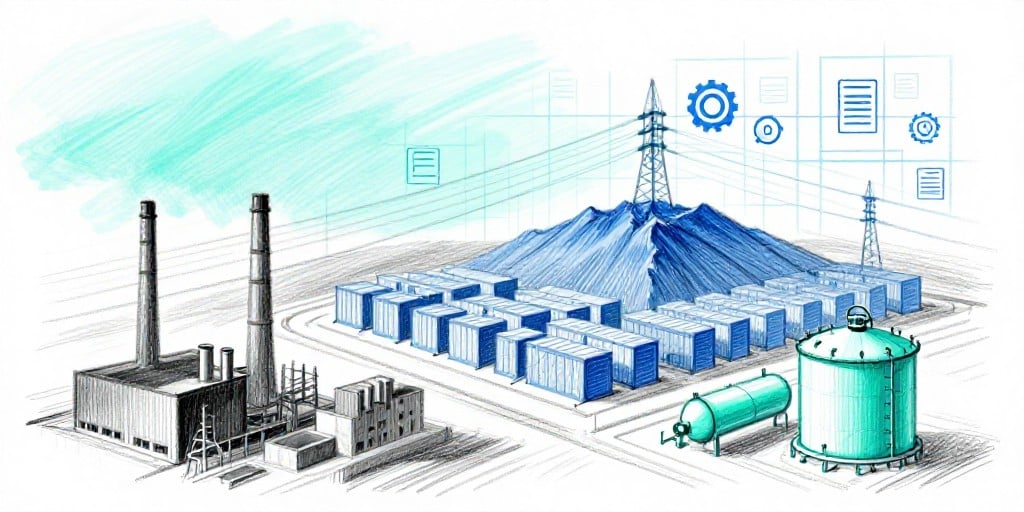
Energy Markets: Production, Storage, and Regulatory Dynamics in 2026
Energy markets continue to evolve at a pace dictated by the interplay of production capacity, storage infrastructure, and regulatory frameworks. In 2026, the sector is navigating a complex landscape shaped by both traditional fossil fuels and the accelerating adoption of renewable technologies. This article examines the technical and economic drivers influencing these dynamics, while incorporating geopolitical considerations that are increasingly pivotal to market behavior.
Production Trends
Fossil Fuels
Oil and natural gas production in the United States remains robust, with the Bureau of Labor Statistics reporting a 4 % year‑over‑year increase in output for the first half of 2026. Technological advancements—particularly in horizontal drilling and hydraulic fracturing—continue to unlock previously inaccessible reserves. However, marginal fields are now facing higher operating costs due to tighter environmental regulations and rising capital expenditures for drilling rigs.
In the refining sector, Delek US Holdings Inc. has maintained a steady throughput of 350 k barrels per day, a figure that aligns with its focus on logistics and midstream services. The company’s recent insider transactions, while routine, underscore the broader market’s confidence in the firm’s production strategy, as reflected in its stable share price and modest dilution.
Renewables
Solar and wind generation have surged, with the U.S. adding 8 GW of new solar capacity in 2025 and 4 GW of wind capacity in 2026. Grid integration challenges—particularly the intermittent nature of these resources—have spurred investment in advanced forecasting and grid‑balancing technologies. Battery storage systems are now deployed at a scale that mitigates curtailment losses, enabling renewable energy to achieve higher penetration levels without compromising grid stability.
Storage Infrastructure
Battery Storage
Lithium‑ion and flow batteries are the cornerstone of modern energy storage. The cost of lithium‑ion technology has fallen by 35 % since 2022, making it economically viable for both utility‑scale projects and distributed generation. In 2026, the U.S. has installed over 3 GW of battery storage, a figure that supports grid resilience during peak demand periods and facilitates the integration of renewables.
Thermal Storage
Thermal storage—particularly molten salt and phase‑change materials—has gained traction in solar thermal plants. These systems enable excess solar energy to be stored during daylight and released during peak evening demand, thereby smoothing supply curves. The capital cost of thermal storage remains higher than battery storage; however, the longer lifespan and lower maintenance costs provide a compelling economic case for large‑scale deployment.
Hydrogen Storage
Hydrogen is emerging as a versatile energy carrier, especially for long‑term storage and heavy‑industrial applications. The United States is investing in hydrogen infrastructure, including underground saline aquifer storage and underground caverns. Technological breakthroughs in electrolyzer efficiency have reduced the cost of green hydrogen to a competitive level, positioning it as a key component of a low‑carbon energy mix.
Regulatory Dynamics
Carbon Pricing
The federal government’s carbon pricing mechanism, capped at $60 per ton by 2030, is exerting upward pressure on fossil fuel costs. This policy incentivizes the shift toward renewables and energy efficiency, thereby reshaping production portfolios for oil and gas companies. The resulting cost pass‑through has led to modest price increases for end users, but the long‑term trajectory remains favorable for clean energy adoption.
Grid Modernization Grants
The Department of Energy’s Grid Modernization Initiative has allocated $12 billion in grants for smart grid technologies and storage projects. These funds accelerate the deployment of real‑time monitoring systems, demand response programs, and distributed energy resources, which collectively enhance grid reliability and reduce operational expenditures.
Export Controls and Geopolitics
Export controls on advanced semiconductor technologies and rare earth elements—essential for renewable energy infrastructure—have intensified due to geopolitical tensions with China. These restrictions are prompting domestic manufacturers to invest in alternative supply chains, thereby increasing the cost of high‑performance photovoltaic modules and wind turbine components. The ripple effect is a temporary uptick in renewable deployment costs, though long‑term benefits are expected as domestic production scales up.
Technical and Economic Factors
Efficiency Gains Advances in photovoltaic cell efficiency—from 20 % to 24 % in commercial modules—reduce the land footprint required for equivalent power output, thereby lowering installation costs and permitting hurdles.
Scale Economies Large‑scale wind farms now benefit from economies of scale, with turbine blade manufacturing costs dropping by 15 % over the past three years. This trend is translating into lower levelized costs of electricity (LCOE) for wind projects.
Energy Density Improved battery chemistries are increasing energy density from 200 Wh/kg to 280 Wh/kg, extending the operational lifespan of storage systems and reducing the frequency of replacements.
Regulatory Certainty Clear policy frameworks, such as the Inflation Reduction Act’s tax credits for renewable projects, provide a stable investment environment, encouraging private sector financing.
Market Liquidity The proliferation of energy futures and options contracts has improved price discovery, allowing producers and utilities to hedge against commodity price volatility effectively.
Geopolitical Considerations
Middle East Stability Political instability in the Middle East continues to influence oil supply dynamics. While the U.S. has diversified its sources, geopolitical risks remain a variable that can prompt rapid adjustments in oil inventory levels and pricing.
China–U.S. Trade Relations Ongoing trade negotiations affect the cost of renewable technology components. Tariffs on solar panels and wind turbine parts can alter the cost structure of renewable projects, influencing investment decisions.
European Energy Policy Europe’s aggressive decarbonization targets are driving a surge in demand for U.S. renewable exports, especially in green hydrogen. This cross‑Atlantic demand is creating new market opportunities for U.S. producers.
Outlook
The confluence of falling renewable costs, strategic storage investments, and supportive regulatory environments suggests a continued shift toward cleaner energy sources. Traditional fossil fuel producers must adapt by diversifying portfolios and embracing carbon capture, utilization, and storage (CCUS) technologies. Meanwhile, storage infrastructure—particularly battery and hydrogen storage—will play a pivotal role in balancing supply and demand, ensuring grid reliability, and accelerating the transition to a decarbonized energy system.
In sum, the energy market of 2026 is characterized by a delicate equilibrium: traditional production remains a significant contributor to the energy mix, yet the inexorable rise of renewable generation, underpinned by storage solutions and forward‑looking regulations, is redefining the economic landscape. Stakeholders across the sector must remain agile, capitalizing on technological advancements while navigating the evolving geopolitical and regulatory terrain.