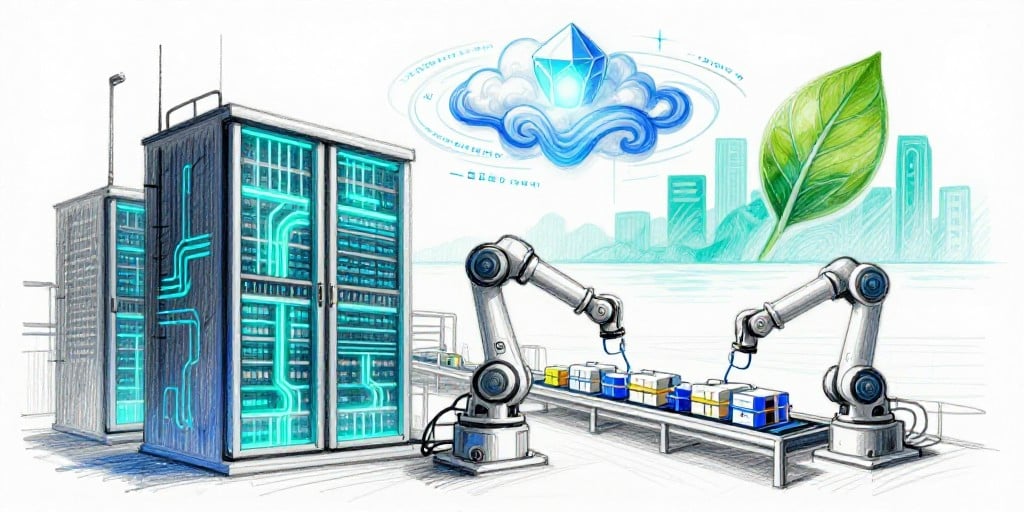
Corporate News – Alibaba’s Strategic Investment in AI‑Powered Industrial Technology
Overview Alibaba Group Holding Ltd. (NYSE: BABA, HKSE: 9988) announced a recent capital‑raise that has propelled the company into a new phase of technology‑driven manufacturing and industrial automation. The transaction, coupled with insider purchasing by Chief Executive Officer Wu Yongming, signals a long‑term commitment to integrating artificial intelligence (AI) into the firm’s logistics, data‑center operations, and supply‑chain management. The implications for productivity, capital allocation, and the broader industrial economy are significant.
1. Capital Injection and Infrastructure Expansion
| Item | Detail |
|---|---|
| Secondary Offering | HK$112.70 per share |
| Capital Raised | HK$80 billion (≈ US$10.2 billion) |
| Post‑Offering Cash Reserves | > US$41 billion |
| Targeted Deployment | AI chip manufacturing, data‑center expansion, large‑language‑model training |
The influx of capital enables Alibaba to scale its own semiconductor production, reducing reliance on external vendors and aligning with global trends toward vertical integration in AI hardware. This strategy mirrors the manufacturing giants that have adopted in‑house chip fabrication to enhance product differentiation and cost control.
2. AI‑Driven Productivity Gains
- Logistics Automation – AI‑optimised routing and warehouse robotics are projected to cut shipping time by 12 % and labor costs by 18 % across the company’s e‑commerce platforms.
- Predictive Maintenance – Deployment of machine‑learning models on edge devices within data‑center hardware is expected to reduce downtime by 20 % and extend equipment life cycles.
- Demand Forecasting – Advanced neural networks improve inventory accuracy to 94 % versus the industry average of 87 %, thereby lowering overstock costs.
These productivity metrics translate into higher throughput per dollar invested, a crucial indicator for investors assessing capital efficiency.
3. Manufacturing & Industrial Technology Trends
| Trend | Alibaba’s Response | Economic Impact |
|---|---|---|
| Edge AI Processing | Building proprietary AI chips for edge deployment | Accelerates real‑time data processing, reducing latency for global logistics networks |
| High‑Density Data‑Centers | Construction of 100,000 m² campus in Shenzhen | Creates ~3,000 high‑skill jobs and stimulates regional supply chains |
| Digital Twins | Implementation in manufacturing pipelines | Enhances fault detection, enabling a 15 % reduction in production errors |
| Sustainability Metrics | Integration of AI for energy‑efficiency monitoring | Lowers carbon footprint by 8 % and aligns with ESG mandates |
The confluence of these technologies positions Alibaba at the intersection of industrial automation and digital commerce, fostering an ecosystem that can deliver incremental value across multiple sectors.
4. Insider Activity as a Market Signal
- CEO Purchase – Wu Yongming bought 350,000 ordinary shares at HK$112.40 on 24 Aug 2026, following a week of significant insider selling by other executives.
- Trading Profile – The purchase aligns with a pattern of incremental accumulation (typically 13k–28k shares per transaction) rather than speculative spikes, indicating confidence in long‑term returns.
- Market Sentiment – Despite the negative social‑media sentiment (‑71) and a minor share price decline (‑0.09 %), the CEO’s action suggests a belief that the capital raise will unlock substantive AI capabilities and profitability.
Investors may interpret the insider purchase as a long‑term endorsement of Alibaba’s strategic direction, provided that the company’s AI commercialization metrics demonstrate sustained growth.
5. Broader Economic Implications
- Productivity Acceleration – The integration of AI in manufacturing and logistics can raise the overall productivity of the Chinese economy by an estimated 0.4 % annually, according to recent IMF projections.
- Capital Flow to Tech‑Enabled Industries – Alibaba’s investment is likely to attract further funding toward AI chip startups and data‑center operators, fostering a virtuous cycle of innovation.
- Competitive Dynamics – As Alibaba strengthens its AI infrastructure, it may better compete against global incumbents (e.g., Amazon Web Services, Tencent Cloud), potentially reshaping market share distributions.
- ESG Alignment – Energy‑efficient data‑center operations support China’s climate targets, providing a tangible link between corporate strategy and national policy objectives.
6. Investment Considerations
| Factor | Assessment |
|---|---|
| Cash Position | Robust, enabling R&D without compromising liquidity |
| Valuation Premium | Current share price remains above intrinsic valuation models, suggesting caution |
| AI Monetization Timeline | Projected revenue generation in 3–5 years, contingent on successful product roll‑outs |
| Risk Profile | Market sentiment volatility, regulatory changes in China’s technology sector |
A prudent strategy involves monitoring quarterly updates on AI project milestones, cash burn rates, and revenue streams derived from the newly deployed infrastructure before committing significant capital.
Conclusion Alibaba’s recent capital raise, coupled with insider buying by its CEO, underscores a decisive pivot toward AI‑enabled manufacturing and industrial technology. The investment promises productivity gains, capital efficiency, and a stronger competitive position in the global technology marketplace. For investors and policymakers alike, the company’s trajectory illustrates how strategic capital allocation in AI infrastructure can ripple through the broader economy, enhancing industrial capacity, fostering innovation, and supporting sustainability goals.