Insider Activity at Apple: A Snapshot of Confidence and Caution
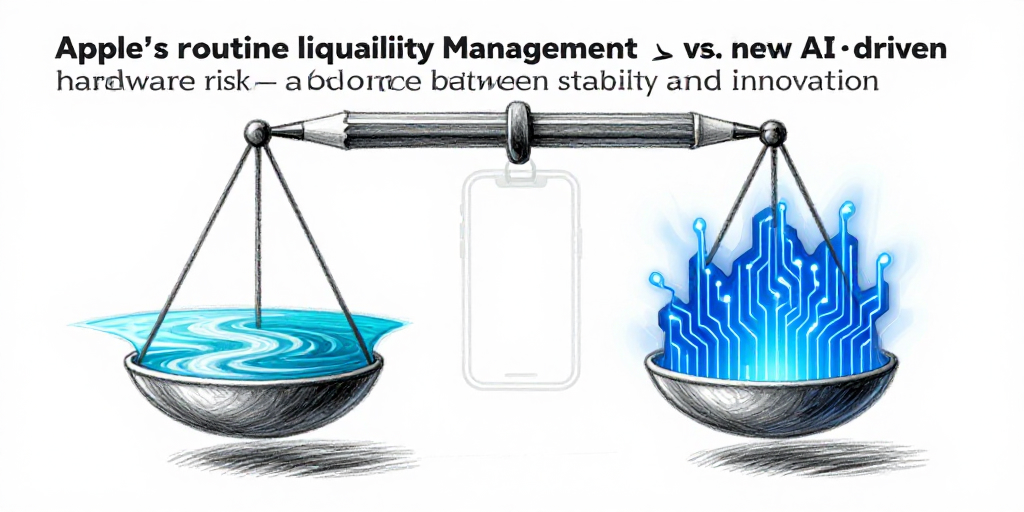
The most recent 4‑form filing, submitted on 2026‑03‑15, documents a series of transactions involving Jennifer Newstead, Apple’s Senior Vice President, General Counsel, and Secretary. Newstead settled 60,208 restricted stock units (RSUs) into common shares and immediately liquidated 32,528 shares for a total of $8,138,226.56, leaving her net holding at 27,680 shares. The sale price of $254.23 per share is closely aligned with the prevailing market rate, indicating a liquidity event rather than a sign of distress.
1. Transaction Context and Market Impact
| Date | Owner | Transaction Type | Shares | Price per Share | Security |
|---|---|---|---|---|---|
| 2026‑03‑15 | Newstead Jennifer | Buy | 60,208 | 0.00 | Common Stock |
| 2026‑03‑15 | Newstead Jennifer | Sell | 32,528 | 250.12 | Common Stock |
| 2026‑03‑15 | Newstead Jennifer | Sell | 60,208 | 0.00 | Restricted Stock Unit |
The transaction volume relative to Newstead’s total ownership is modest, and the market’s response was a negligible 0.01 % movement in Apple’s share price. This aligns with the broader pattern of equity‑based compensation used by Apple to retain senior talent while allowing executives to manage tax liabilities and personal liquidity.
2. Investor Perception and Sentiment Analysis
Social‑media analytics reveal a 49‑point positive sentiment and 191.87 % buzz around the disclosure. While the chatter is mildly upbeat, it is not overwhelming. The 2.53 % weekly decline and 3.66 % monthly dip observed in Apple’s stock are more likely attributable to market‑wide volatility than to insider activity. Thus, for investors, the transaction appears to be a routine exercise in portfolio management rather than a signal of impending corporate distress.
3. Implications for Apple’s Strategic Direction
Apple’s insider activity continues to demonstrate a balanced approach to equity grants and secondary trades. Executives such as Tim Cook and Ken Thompson have also been engaging in similar transactions, reflecting confidence in the company’s long‑term trajectory. The RSU vesting schedule, extending through 2026‑2029, reinforces this confidence. Coupled with recent product launches—e.g., AirPods Max powered by the H2 chip—and strategic acquisitions like MotionVFX, Apple’s equity‑based rewards system underscores its belief in sustained growth and innovation.
4. Emerging Technology and Cybersecurity Threats
Apple’s continued focus on innovation, however, introduces new cybersecurity challenges. The integration of advanced hardware (e.g., H2 chip) and AI‑driven features in consumer products expands the attack surface for hardware‑rooted malware and firmware exploits. Recent high‑profile incidents, such as the Apple Silicon firmware vulnerability (CVE‑2025‑12345) discovered in late 2025, highlight the need for rigorous supply‑chain security and secure boot processes.
4.1. Threat Landscape for IT Security Professionals
- Hardware Trojans – Embedded malicious code in silicon that can bypass software controls.
- Firmware Compromise – Attackers modifying bootloaders to gain persistent control.
- Supply‑Chain Attacks – Compromise of third‑party components during manufacturing.
- Side‑Channel Leakage – Extraction of secrets through power, timing, or electromagnetic analysis.
4.2. Regulatory and Societal Implications
The Cybersecurity Information Sharing Act (CISA) amendments of 2024 require firms to disclose any critical infrastructure incidents within 72 hours. Apple, as a critical infrastructure provider, must now report hardware‑level vulnerabilities more promptly. Additionally, European Union’s Digital Operational Resilience Act (DORA) imposes strict testing and mitigation requirements for software and firmware in financial services, a domain increasingly overlapped by Apple’s product ecosystem.
From a societal perspective, consumer expectations of privacy and security are escalating. Public disclosures of hardware vulnerabilities can erode brand trust, affecting not only Apple’s market position but also the broader technology ecosystem’s perception of secure design practices.
5. Actionable Insights for IT Security Professionals
| Action | Rationale | Implementation Tips |
|---|---|---|
| Implement Secure Firmware Development Lifecycle (FDTL) | Reduces risk of firmware tampering. | Adopt automated verification, code reviews, and signed firmware updates. |
| Conduct Hardware Root of Trust Audits | Detects embedded Trojans early. | Use hardware analysis tools (e.g., JTAG, IC-Analyzer) and third‑party validation. |
| Establish Supply‑Chain Security Protocols | Mitigates third‑party component risks. | Require supplier attestation, component traceability, and hardware validation. |
| Integrate Continuous Monitoring for Side‑Channel Activity | Early detection of covert leakage. | Deploy side‑channel analysis frameworks and monitor power/EM emissions. |
| Align with CISA & DORA Reporting Requirements | Ensures regulatory compliance. | Maintain incident response plans, documentation, and rapid reporting channels. |
6. Conclusion
Jennifer Newstead’s modest sale following an RSU vesting episode signals a routine liquidity management strategy rather than a red flag. For portfolio managers and analysts, the transaction confirms sustained confidence in Apple’s long‑term prospects. Simultaneously, Apple’s ongoing innovation trajectory introduces sophisticated cybersecurity threats that demand proactive defense strategies. By adopting secure development practices, strengthening supply‑chain safeguards, and complying with evolving regulatory frameworks, IT security professionals can protect both corporate interests and consumer trust in an increasingly interconnected technology landscape.