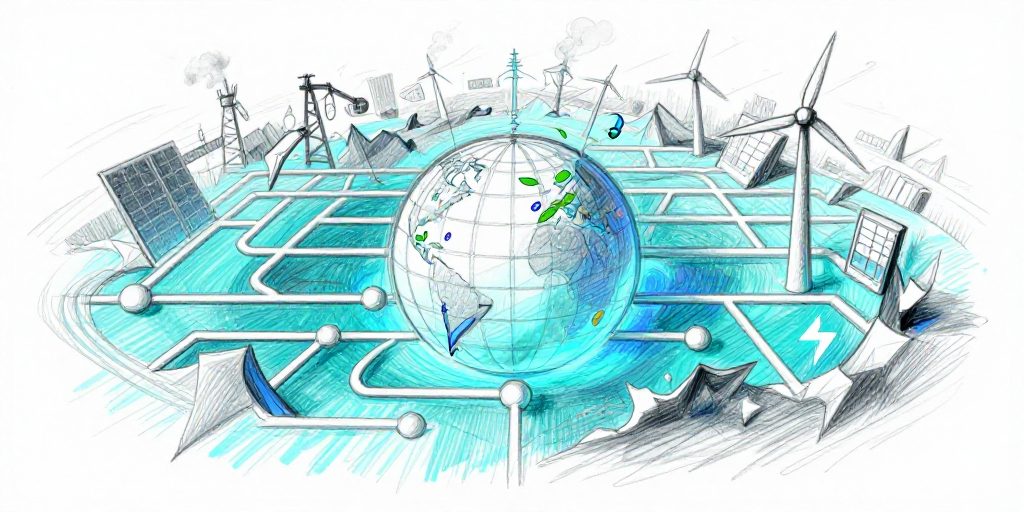
Energy Markets: Production, Storage, and Regulatory Dynamics in 2026
The global energy landscape in 2026 continues to evolve under the twin pressures of escalating demand and aggressive decarbonisation mandates. While traditional fossil‑fuel production remains a critical pillar of the world’s energy mix, renewable generation and advanced storage technologies are rapidly reshaping supply dynamics and regulatory frameworks. This article examines the technical and economic drivers influencing both sectors, with a particular focus on how geopolitical considerations are intersecting with market fundamentals.
1. Production Trends
1.1 Conventional Energy
Natural gas production in the United States remains a key source of dispatchable power, driven by the continued growth of liquefied natural gas (LNG) export infrastructure. Production has plateaued in the Gulf of Mexico but has expanded modestly in the Permian Basin and the Marcellus shale, thanks to advances in hydraulic fracturing and horizontal drilling. However, the sector faces a growing competitive pressure from renewable sources, particularly as the cost of wind and solar has fallen to less than half of their 2010 levels.
On the oil front, Brent crude prices have stabilized around $80‑$90 per barrel, reflecting a delicate balance between OPEC+ production cuts and the rebound of non‑OPEC output, notably from the United States and Canada. The continued deployment of carbon capture, utilisation and storage (CCUS) projects in the Permian Basin and the Gulf of Mexico indicates a tentative shift toward lower‑carbon fossil production.
1.2 Renewable Energy
Solar photovoltaic (PV) capacity additions have outpaced all other generation sources in 2025, with a cumulative global installation exceeding 1.5 TW. The decline in silicon wafer costs, coupled with improved panel efficiencies (now routinely above 22 %), has propelled the sector into new markets in Asia and Europe. Meanwhile, wind power has benefitted from larger, more efficient turbine designs—particularly 12 MW offshore units—and a robust supply chain for blade production.
Hydropower remains the largest renewable source, but its growth potential is limited by geographic constraints. However, emerging small‑scale and pumped‑storage technologies are opening new opportunities in regions previously considered unsuitable for large dams.
2. Storage and Grid Integration
The proliferation of intermittent renewables has amplified the demand for advanced storage solutions. Battery‑energy‑storage systems (BESS) are now the most common form of grid‑scale storage, with global deployments exceeding 80 GW in 2025. Lithium‑ion batteries have become cost‑competitive with traditional pumped storage, especially in areas with high solar penetration.
Simultaneously, hydrogen production via electrolysis—powered by surplus renewable capacity—has gained traction as a medium‑term storage medium. Several pilot projects in Germany, the Netherlands, and the United Arab Emirates have demonstrated the viability of green hydrogen for both power‑to‑gas and transportation applications.
Regulatory frameworks are adapting to these new technologies. In the United States, the Federal Energy Regulatory Commission (FERC) has revised its market rules to accommodate battery storage as a market participant, while the European Union is implementing the Clean Energy for All Europeans Package, which mandates storage participation in balancing markets.
3. Technical and Economic Drivers
3.1 Cost Competitiveness
The levelised cost of energy (LCOE) for utility‑scale solar has fallen below $30 per megawatt‑hour in many regions, surpassing the LCOE of new gas‑fired plants in most developed markets. Wind LCOE is similarly competitive, particularly offshore. In contrast, conventional coal plants are increasingly uneconomical once carbon pricing and emission regulations are considered.
3.2 Reliability and Flexibility
Fossil‑fuel plants still provide essential baseload and quick‑start capabilities that storage and renewables cannot fully replace. However, the integration of demand‑response programmes and flexible gas plants—such as gas turbines with rapid ramp rates—has begun to fill the gap created by intermittent renewable generation.
3.3 Supply Chain Resilience
The recent geopolitical tensions in Eastern Europe have underscored the vulnerability of energy supply chains. Countries are now diversifying their sources, investing in domestic renewable projects, and building strategic reserves of critical materials such as rare earth elements and lithium. This shift is prompting a re‑evaluation of long‑term contracts and a greater emphasis on localised production.
4. Geopolitical Considerations
4.1 Energy Security
Russia’s annexation of Ukraine has accelerated European efforts to reduce dependence on Russian gas, leading to a surge in LNG imports from the United States and Qatar. This shift has created volatility in global LNG pricing and highlighted the need for diversified supply routes, including the proposed Southern Corridor pipeline from the United States to the Middle East.
4.2 Trade Policies
The United States–China trade negotiations have impacted the global supply of solar panels, with tariffs on solar imports affecting price dynamics in the United States and Europe. Likewise, the United Kingdom’s post‑Brexit energy policy is redefining cross‑border grid interconnectors, affecting how renewable surplus is transmitted across the continent.
4.3 Climate Commitments
The Paris Agreement and subsequent national commitments to net‑zero emissions have driven regulatory changes worldwide. Governments are implementing stricter emission standards for fossil‑fuel plants and offering incentives for renewable investment. These policies are reshaping capital allocation patterns, with a growing proportion of investment flowing into low‑carbon projects.
5. Outlook
The trajectory of energy markets in 2026 points toward a gradual but sustained shift from fossil fuels to a diversified portfolio that balances renewables, advanced storage, and flexible conventional generation. Regulatory evolution, technological advancements, and geopolitical dynamics will continue to shape the pace and scale of this transition. Investors and policymakers must therefore remain attuned to the interplay of technical feasibility, economic viability, and geopolitical risk in order to navigate the evolving energy landscape successfully.