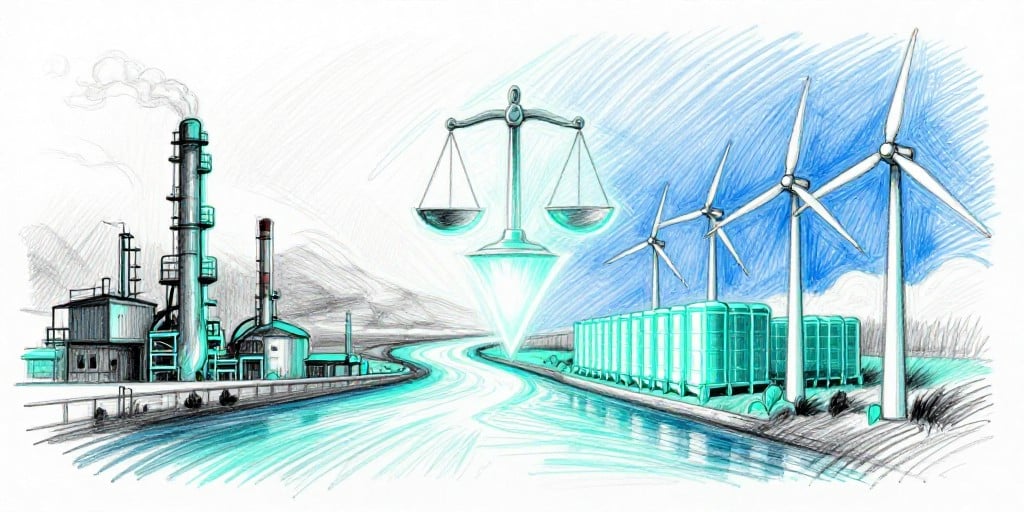
Energy Market Dynamics Amidst Recent Corporate Transactions
Production Trends in Conventional and Renewable Sectors
The global energy landscape remains heavily weighted toward conventional hydrocarbon production, yet the rate of growth in this segment is decelerating. In the United States, onshore shale plays—particularly the Permian Basin and the Eagle Ford—have seen a decline in new drilling activity following the 2023 production peak. This slowdown is driven by a combination of higher operating costs, tighter regulatory scrutiny, and the mounting capital demand for renewable infrastructure projects.
Conversely, renewable generation is experiencing a robust expansion trajectory. Solar photovoltaic (PV) installations continue to lead growth in electricity generation capacity, with a year‑over‑year increase of 12 % globally in 2025. Offshore wind, although still in the early stages of deployment, has seen a 22 % rise in installed capacity in the European Union, underpinned by the European Commission’s 2030 renewable energy targets. The cost of renewable electricity has declined markedly, reaching an average of 6.5 ¢ per kilowatt‑hour in 2025—a 15 % reduction from the previous year—making it increasingly competitive with traditional fossil fuel generation.
Storage Capabilities and Their Strategic Importance
Energy storage has emerged as a critical component of both conventional and renewable supply chains. For traditional sectors, storage facilities—such as midstream hubs and on‑site tank farms—enable producers to hedge against volatile spot prices and to align output with peak demand periods. In the renewable domain, battery energy storage systems (BESS) and pumped‑hydro installations are essential for mitigating the intermittency of wind and solar sources, thereby improving grid reliability and reducing curtailment.
In 2025, global investments in energy storage exceeded $45 billion, with a significant share directed toward grid-scale lithium‑ion battery projects in the United States and China. The regulatory environment in the United States has evolved to support these developments, with the Federal Energy Regulatory Commission (FERC) expanding the definition of “storage” in its market rules to include battery systems. This regulatory shift has accelerated the integration of renewable sources into the wholesale market.
Regulatory Dynamics and Their Impact on Market Participants
Regulatory frameworks continue to shape the operational and financial realities of both energy sectors. Key developments include:
| Regulation | Year | Impact |
|---|---|---|
| FERC Order 2024‑12 (Battery Storage) | 2024 | Expands storage definition, lowers market entry barriers |
| EU Renewable Energy Directive 2025 | 2025 | Sets binding targets for member states, incentivises offshore wind |
| U.S. Corporate Sustainability Reporting Standards | 2025 | Mandates disclosure of GHG emissions, influencing investor decisions |
| UK Net Zero Strategy 2026 | 2026 | Imposes carbon pricing and renewable energy mandates |
These regulations collectively encourage a gradual shift toward decarbonized power generation while preserving the economic viability of conventional energy producers through targeted subsidies and tax incentives. The interplay between federal, state, and international policies is creating a heterogeneous regulatory landscape that demands strategic agility from firms operating across borders.
Technical and Economic Drivers in Traditional Energy
The economics of conventional energy are increasingly influenced by three intertwined technical factors:
- Enhanced Recovery Techniques: The adoption of advanced hydraulic fracturing and horizontal drilling has extended the life of mature fields, delaying the need for new exploration.
- Digitalization of Operations: Real‑time monitoring and predictive analytics reduce downtime, lowering operating costs by an estimated 5–7 % annually.
- Carbon Capture and Utilization (CCU): Integration of CCU technologies is beginning to offset the carbon intensity of natural gas plants, improving their regulatory standing and potentially generating new revenue streams through carbon credits.
The cumulative effect of these factors has maintained oil and gas margins at roughly 8 % over the past two years, despite price volatility in the spot market. However, the high capital expenditure associated with CCU projects—estimated at $4–6 billion per facility—poses a barrier for smaller operators.
Renewable Energy Economics and Technological Evolution
Renewable energy economics are driven by rapid cost reductions and technological advancements:
- Photovoltaic Efficiency Gains: The industry average efficiency of commercial PV modules has risen from 17 % in 2015 to 22 % in 2025, improving electricity yield by 30 % per unit area.
- Battery Energy Density: Advances in cathode materials have increased lithium‑ion battery energy density from 250 Wh/kg to 400 Wh/kg, reducing installation costs by 18 %.
- Grid Integration Software: Sophisticated forecasting algorithms now enable utilities to schedule renewable generation with 95 % accuracy, enhancing reliability and reducing curtailment rates.
These technological strides translate into a lower levelized cost of electricity (LCOE) for renewables, projected to fall below $30 per megawatt‑hour in the United States by 2030—outperforming many conventional power plants.
Geopolitical Considerations and Market Volatility
Geopolitical tensions continue to exert pressure on energy markets, with implications for both production and pricing:
- Middle Eastern Geopolitics: Ongoing disputes in the Eastern Mediterranean have led to fluctuating supply from major oil producers, contributing to a 5 % rise in crude prices in late 2025.
- U.S.–China Trade Dynamics: Tariffs on renewable technology components, such as solar panels and wind turbine blades, have increased import costs for U.S. manufacturers by 12 % over the past year.
- European Energy Security: The European Union’s emphasis on reducing reliance on Russian gas has accelerated investments in LNG terminals and renewable hydrogen projects, diversifying supply sources but adding complexity to long‑term contracts.
These geopolitical factors feed into the risk premium demanded by investors, which in turn influences capital allocation decisions within both the traditional and renewable sectors.
Conclusion
The convergence of evolving production practices, expanding storage capabilities, and a dynamic regulatory environment is redefining the competitive landscape of the energy sector. While conventional hydrocarbon production remains a vital component of the global energy mix, its economic viability is increasingly tied to technological innovation and regulatory compliance. Renewable energy, buoyed by cost reductions and supportive policies, is poised to capture a larger share of the market, yet it must navigate supply chain challenges and geopolitical uncertainties. Investors and corporate strategists alike must maintain a nuanced understanding of these intertwined technical, economic, and geopolitical factors to navigate the next phase of energy transition successfully.