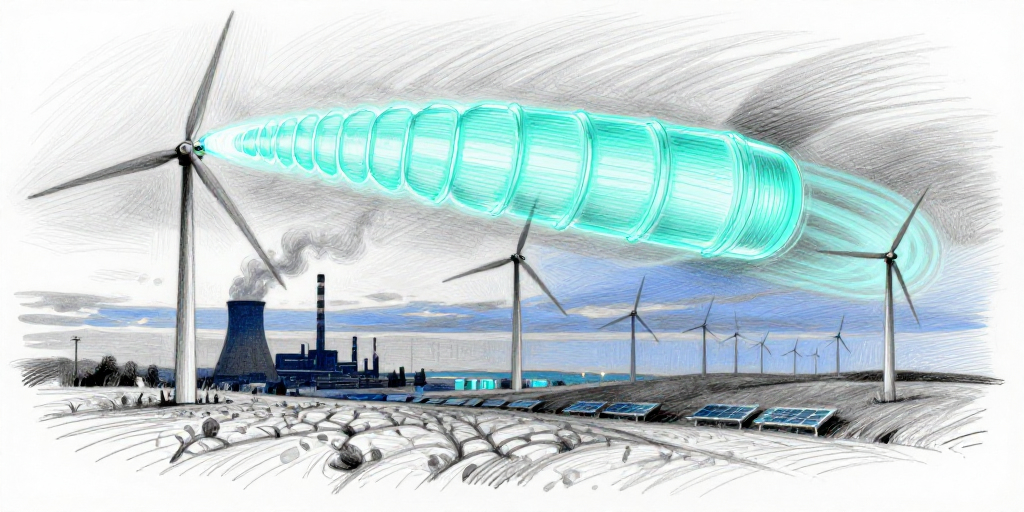
Energy Markets Analysis: Production, Storage, and Regulatory Dynamics
Overview of Current Production Trends
In recent months, the global energy landscape has continued to evolve under the dual pressures of traditional fossil‑fuel demand and the rapid expansion of renewable generation. Natural gas, in particular, remains the most widely used intermediate‑fuel, supplying approximately 28 % of global electricity generation in 2025. Production in the United States has plateaued, while European output has been modestly depressed by post‑pandemic supply chain constraints and geopolitical tensions in Eastern Europe. Offshore wind and solar photovoltaics have recorded record installations, with the United Kingdom and China leading the way in 2025‑2026. The shift toward higher capacity factors for renewables—reaching 45 % in wind farms located in the North Sea—has started to erode the comparative advantage of gas‑based peaking plants.
Storage as a Balancing Mechanism
The rapid growth of intermittent resources has necessitated a corresponding expansion in storage capacity. Battery energy storage systems (BESS) have seen a 42 % annual increase in installed capacity, largely driven by utility‑scale projects in the United States and Germany. Hydrogen storage is also gaining traction, particularly in the context of the European Green Deal, which aims to capture up to 3 Mt CO₂ annually by 2030 through blue‑hydrogen pathways. Natural‑gas storage facilities in the U.S. have been operating at an average of 85 % of their annualized capacity, indicating a strong demand for flexibility services such as load shifting and grid stabilization.
Regulatory Dynamics and Market Liberalization
Regulatory frameworks continue to shape investment decisions in both the traditional and renewable sectors. In the United States, the Federal Energy Regulatory Commission (FERC) has streamlined the permitting process for offshore wind, reducing lead times from 18 months to under 12 months for projects meeting minimum environmental thresholds. Conversely, the European Union’s Emission Trading System (ETS) has tightened allowances, pushing the cost of carbon from €33 / t CO₂ in 2024 to an estimated €60 / t by 2026. This escalation is accelerating the retirement of coal plants and the upgrade of natural‑gas turbines to higher efficiencies.
In emerging markets, India’s “National Solar Mission” has introduced feed‑in tariffs that guarantee a minimum price of $0.03 / kWh for solar installations until 2028, thereby reducing the risk premium for renewable developers. However, regulatory uncertainty remains a key concern, particularly in regions where power sector reforms are ongoing.
Technical Factors Affecting Traditional Energy
Methane Leakage and Efficiency – Advances in pipeline integrity monitoring and leak‑detection technologies have reduced methane emissions by 8 % in 2025, improving the life‑cycle greenhouse gas (GHG) intensity of natural gas by roughly 3 %. This technical improvement supports the continued use of natural gas as a transition fuel.
Ultra‑High Capacity Turbines – The introduction of 120 MW gas turbines with 60 % net efficiency has allowed operators to reduce capital expenditure (CAPEX) by 15 % compared to older 80 MW units, thereby making gas peaking plants more competitive against battery storage for short‑duration peak shaving.
Carbon Capture and Storage (CCS) – While CCS technology remains capital intensive, the cost of capturing CO₂ from a 1‑GW gas plant is projected to decline from $60 / t CO₂ in 2026 to $45 / t by 2030, primarily due to economies of scale in commercial projects such as the Petra Nova retrofit.
Technical Factors Affecting Renewable Energy
Wind Turbine Blade Materials – New composite materials have extended blade lifespans by 10 % and reduced maintenance downtime, resulting in higher capacity factors across wind farms in the North Sea and Gulf of Mexico.
Photovoltaic (PV) Cell Efficiency – The adoption of perovskite–silicon tandem cells has pushed commercial module efficiencies from 20.3 % to 23.1 % in 2026, enabling a 12 % increase in electricity yield per installed kW.
Energy Storage Integration – Coupling BESS with renewable farms has improved dispatchability, allowing solar farms to sell electricity at peak prices and reducing the need for curtailment, which historically accounted for 3 % of total solar output in 2025.
Economic Considerations
Capital Expenditure (CAPEX): The CAPEX for offshore wind has fallen by 25 % since 2019 due to economies of scale and improved supply chain efficiencies. In contrast, natural‑gas turbine CAPEX has plateaued, maintaining a cost advantage for peaking services.
Operating Expenditure (OPEX): The OPEX for renewable plants continues to be lower per kWh generated than for gas plants, but the higher OPEX associated with maintenance of complex storage systems introduces new cost structures.
Price Volatility: Energy prices in Europe have been volatile, with natural‑gas spot prices fluctuating between €60 / MWh and €80 / MWh in 2025. Renewables, especially those with long-term power purchase agreements (PPAs), are less exposed to this volatility.
Demand Forecasts: Projections indicate that global electricity demand will grow by 2.3 % annually through 2030, with renewable penetration expected to reach 55 % of total generation by 2030. Natural gas is projected to retain a 25 % share as a balancing fuel.
Geopolitical Considerations
Energy Security Post‑Ukraine Conflict – The Russian invasion of Ukraine has accelerated efforts to diversify natural‑gas supplies. Countries like Poland and Finland are investing heavily in LNG terminals to reduce dependence on pipeline gas from Russia.
US–China Trade Tensions – Tariffs on solar equipment have increased costs for Chinese manufacturers, leading to a 7 % rise in PV module prices in 2026. This has prompted several European countries to diversify supply chains, favoring German and Taiwanese suppliers.
Middle East Stability – OPEC’s decision to maintain a 1 Mt / day production quota in 2026 has stabilized crude oil prices but has not significantly impacted natural‑gas markets, given the divergent supply chains and geopolitical risk profiles.
Climate Agreements – The Paris Agreement commitments and the EU Green Deal have led to stricter regulatory environments. Nations adopting carbon pricing mechanisms are incentivizing investment in low‑carbon technologies, influencing both capital allocation and technology development trajectories.
Conclusion
The energy market remains at a critical juncture, where production, storage, and regulatory dynamics intertwine to shape the competitive landscape of both traditional and renewable sectors. Technological advances in efficiency and storage are gradually reducing the relative cost advantage of fossil fuels, while regulatory incentives and geopolitical pressures are accelerating the shift toward cleaner energy sources. Investors and policymakers must closely monitor CAPEX trends, OPEX structures, and regulatory developments to assess the evolving risk‑return profiles of energy assets.