
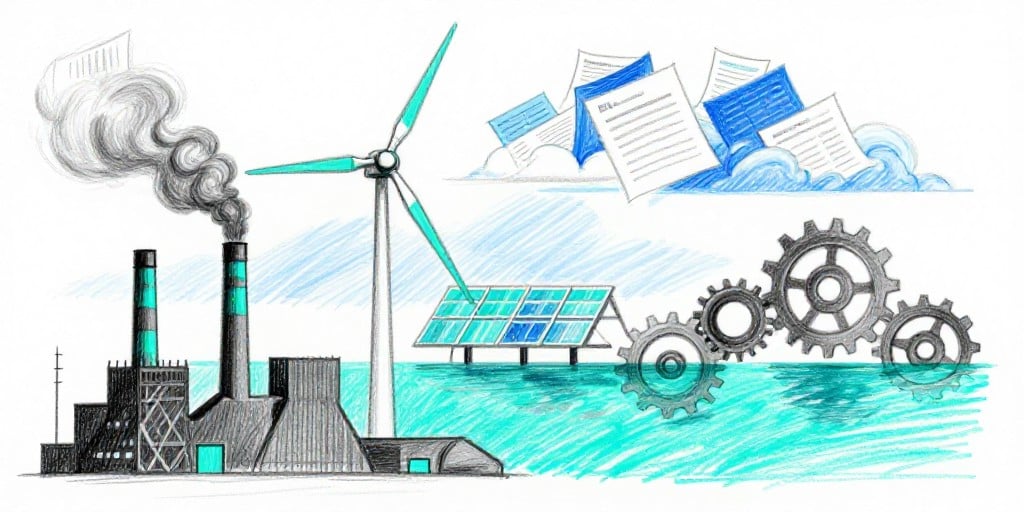
Analysis of Energy Market Dynamics: Production, Storage, and Regulation
1. Current Production Landscape
The global energy mix continues to evolve under the dual pressures of supply constraints and decarbonisation targets. Conventional fossil‑fuel production—particularly crude oil and natural gas—remains a cornerstone of the industry, yet the pace of new development has slowed. In the United States, the Bureau of Economic Analysis reports that oil and natural‑gas production rose 3.8 % in the first quarter of 2026, driven primarily by increased output in the Permian Basin and offshore Gulf of Mexico projects. In contrast, European gas production has contracted due to the phase‑out of the Netherlands’ largest gas field and the shutdown of several aging platforms.
Renewable production has seen a markedly faster trajectory. Solar photovoltaic (PV) installations in the Middle East and Asia‑Pacific have grown at a 22 % compound annual growth rate (CAGR) over the past five years, reaching a cumulative capacity of 1.2 TW globally. Wind power, both onshore and offshore, has expanded by 18 % annually, with offshore projects in the North Sea and Baltic Sea attracting significant investment from sovereign wealth funds and private equity.
2. Storage Capacity and Its Strategic Significance
Storage plays a critical role in balancing supply and demand, especially for intermittent renewables. Natural‑gas storage facilities in the United States now hold an estimated 1.5 trillion cubic feet (Tcf) of gas, a 12 % increase over the 2025 baseline, thanks to the construction of new underground caverns and the retrofitting of depleted oil fields. This expansion enhances gas security, allowing producers to smooth seasonal price fluctuations and meet peak demand during winter.
In the renewable sector, battery storage has become a cost‑competitive complement to traditional pumped‑hydro and compressed‑air systems. Tesla’s Megapack deployments in Texas and California illustrate the commercial viability of utility‑scale lithium‑ion solutions, which have seen an average cost decline of 35 % since 2018. Meanwhile, hydrogen storage, both in liquid and solid forms, is emerging as a medium‑term strategy for long‑duration energy displacement, particularly in the transportation and industrial sectors.
3. Regulatory Dynamics and Their Economic Implications
3.1 Carbon Pricing and Emissions Regulations
Carbon pricing mechanisms—such as the European Union Emission Trading System (EU ETS) and the United States’ federal Clean Power Plan—continue to exert upward pressure on operating costs for fossil‑fuel producers. The EU ETS, for instance, projected a 4.3 % increase in allowance prices in 2026, translating into a roughly 1.2 % cost increase for gas‑fired power plants. Conversely, renewable generators receive a carbon‑price advantage, effectively receiving a subsidy equivalent to the avoided emissions cost.
3.2 Maritime Emissions Standards
The International Maritime Organization’s (IMO) 2020 sulphur cap and the forthcoming 2030 and 2050 zero‑emission mandates are reshaping the shipping and energy transport sectors. Shipping companies are increasingly investing in low‑sulphur fuels, liquefied natural gas (LNG) bunkers, and alternative propulsion technologies. The rise in fuel costs has led to a 5 % increase in freight rates for tankers in the last quarter of 2025, which in turn boosts revenues for energy transport operators.
3.3 Grid Integration Policies
The United States’ Federal Energy Regulatory Commission (FERC) has implemented new interconnection standards to facilitate the integration of distributed energy resources (DERs). The revised FERC Order 2222, adopted in 2024, reduces the administrative burden on renewable developers, allowing for a 30 % faster permitting process. In Europe, the European Commission’s 2026 Clean Energy Package aims to standardise grid codes across member states, encouraging cross‑border renewable trade and reducing curtailment risks.
4. Technical Factors Shaping the Energy Transition
4.1 Efficiency Improvements
Advances in turbine technology have lifted the efficiency of wind farms from 35 % to 48 % over the past decade, thanks to taller rotors and improved blade materials. Solar PV panels now exceed 22 % efficiency in commercial installations, propelled by tandem perovskite‑silicon cells that have demonstrated laboratory efficiencies of 29 %. These technical gains lower the levelised cost of energy (LCOE) for renewables, intensifying competition with fossil fuels.
4.2 Energy Storage Integration
Grid‑scale battery storage now supports grid stability by providing frequency regulation, voltage support, and peak shaving. According to the International Renewable Energy Agency (IRENA), the deployment of battery storage in the United States increased by 42 % in 2025, with a cumulative installed capacity of 1.9 GWh. This infrastructure mitigates the “duck curve” effect, enabling higher renewable penetration without compromising grid reliability.
5. Economic Drivers and Market Sentiment
5.1 Demand Forecasts
The International Energy Agency (IEA) projects that global electricity demand will rise by 2.7 % annually through 2030, with renewables accounting for 70 % of new capacity additions. In the petrochemical sector, the demand for hydrocarbons is expected to plateau by 2035, signalling a shift towards more circular and low‑carbon feedstocks.
5.2 Investment Trends
Venture capital and private equity have directed more than $150 billion toward renewable energy projects in 2025, a 15 % increase over the previous year. Government incentives, such as the U.S. Inflation Reduction Act, have accelerated capital deployment by reducing tax credit uncertainty.
5.3 Geopolitical Influences
The Russia‑Ukraine conflict has underscored the strategic importance of energy security. European countries have accelerated diversification away from Russian gas, prompting increased imports of LNG from the United States and Qatar. Meanwhile, the United States has bolstered domestic shale production to supply its own maritime fleet, indirectly supporting the logistics of energy transport companies.
6. Conclusion
Energy markets are at a pivotal juncture, with traditional production channels grappling with regulatory pressure and renewable sources accelerating due to technical and economic advantages. Storage solutions are bridging the intermittency gap, while regulatory frameworks are progressively aligning incentives for cleaner energy. Investors and policymakers must navigate this complex interplay of production, storage, and regulation to harness the opportunities presented by a decarbonising energy landscape.