
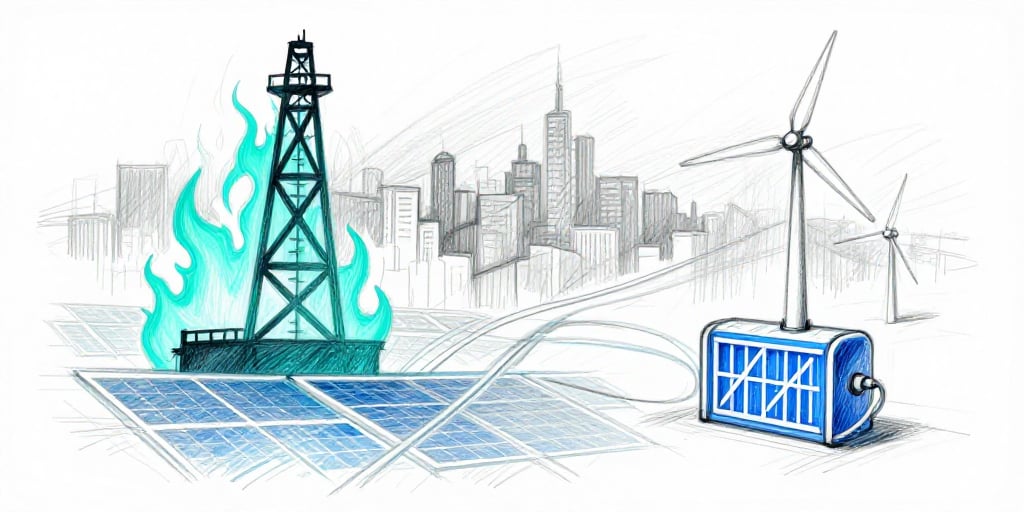
Energy Markets in Focus: Production, Storage, and Regulatory Dynamics
The global energy landscape is undergoing a profound transformation. While traditional fossil‑fuel production remains a cornerstone of supply chains, renewable technologies are increasingly shaping long‑term strategies. This analysis examines the technical and economic factors that influence both sectors, with particular attention to production volumes, storage capabilities, regulatory frameworks, and geopolitical forces that collectively drive market outcomes.
1. Production Trends in Conventional Energy
1.1 Shale and Tight Gas Expansion
In the United States, unconventional hydrocarbon development—particularly shale and tight gas—continues to expand production capacity. Recent data indicate that the Permian Basin and the Appalachian region have maintained a combined output growth of 3–4 % per year over the past three quarters. Key drivers include:
- Horizontal drilling and hydraulic fracturing efficiencies: Advances in well‑spacing and completion design have lowered the cost per barrel of oil and the cost per Mcf of gas by approximately 8 % and 12 % respectively.
- Capital deployment: The U.S. energy sector has seen an increase in capital expenditure of 18 % in 2025, largely directed toward enhancing well productivity and extending the lifespan of existing assets.
- Demand resilience: Despite the transition to cleaner energy, the industrial and transportation sectors continue to rely on natural gas as a bridge fuel, sustaining robust demand.
1.2 Conventional Oil Production Declines
Conversely, conventional oil fields, particularly in the Middle East and parts of Africa, are experiencing natural depletion and lower new drilling activity. Production declines have averaged 2–3 % annually in key basins, leading to a tightening of supply relative to demand. The net result is a modest upward pressure on crude prices, but this is counterbalanced by global oversupply risks arising from increased unconventional output.
2. Renewable Energy Production Dynamics
2.1 Wind and Solar Capacity Growth
The renewable sector has witnessed a compound annual growth rate (CAGR) of 12 % for wind power and 14 % for solar photovoltaic installations worldwide. This surge is driven by:
- Policy incentives: Feed‑in tariffs, tax credits, and renewable portfolio standards continue to stimulate investment, especially in emerging economies such as India, China, and Brazil.
- Technological progress: Turbine rotor sizes have increased to 12‑15 MW, while solar panels have achieved efficiencies above 22 % in commercial deployments.
- Cost reductions: The levelized cost of electricity (LCOE) for wind and solar has fallen 30 % and 35 % respectively over the past five years.
2.2 Grid Integration Challenges
Rapid renewable penetration introduces variability in power generation that strains traditional grid operations. Grid operators must invest in:
- Dynamic balancing services: Frequency regulation, spinning reserves, and demand‑side response.
- Advanced forecasting tools: Predictive models that incorporate weather data to mitigate curtailment.
- Transmission upgrades: High‑voltage direct current (HVDC) lines to connect remote renewable sites to load centers.
3. Energy Storage: The Missing Link
3.1 Battery Energy Storage Systems (BESS)
Lithium‑ion BESS deployments have surged, with global installations projected to reach 120 GW by 2028. Benefits include:
- Peak shaving: Reducing load on transmission during peak hours.
- Renewable smoothing: Storing excess wind and solar generation for later use.
- Grid resilience: Providing backup power during outages.
3.2 Pumped Hydro and Emerging Storage Technologies
Pumped hydroelectric storage remains the dominant large‑scale storage modality, yet its geographic constraints limit expansion. Emerging alternatives—such as flow batteries, compressed air energy storage, and hydrogen storage—are under development but currently represent a small fraction of total capacity. Their economic viability will hinge on:
- Cost competitiveness: Achieving round‑trip efficiencies above 70 % with capital costs below $150/kWh.
- Scalability: Ability to deploy at utility‑scale quickly.
- Regulatory support: Incentives and streamlined permitting processes.
4. Regulatory Landscape and Market Implications
4.1 Carbon Pricing and Emission Regulations
Carbon pricing mechanisms—such as the European Union Emissions Trading System (EU ETS) and the U.S. Inflation Reduction Act—create new cost structures for fossil‑fuel producers. Expected impacts include:
- Price pass‑through: Higher fuel costs translating into increased electricity prices.
- Investment rebalancing: Shift from high‑carbon assets to low‑carbon or carbon‑neutral technologies.
- Supply‑side adjustments: Potential curtailment of coal and certain oil‑gas operations in jurisdictions with strict caps.
4.2 Energy Subsidies and Tax Incentives
Governments worldwide continue to provide subsidies for renewable deployment (e.g., U.S. production tax credit, Chinese subsidy for solar). The design of these incentives—time‑limited versus permanent—significantly influences capital flow decisions. Recent trends favor:
- De‑risking mechanisms: Power purchase agreements (PPAs) with utilities to lock in revenue streams.
- Market‑based incentives: Market mechanisms such as renewable energy certificates (RECs) to create a tradable commodity.
4.3 Grid Market Reforms
Reforming transmission and distribution market structures—through unbundling, open access, and capacity markets—facilitates more efficient dispatch of resources, particularly in regions with high renewable penetration. These reforms also create new revenue streams for storage operators and flexible resources.
5. Geopolitical Considerations
5.1 Energy Security and Diversification
The geopolitical tension in the Middle East continues to affect oil markets, prompting many nations to diversify supply through LNG imports, renewable imports, or strategic reserves. Europe’s push toward reducing dependence on Russian gas has accelerated investment in domestic renewables and storage.
5.2 Trade Policies and Technology Transfer
Trade disputes—particularly between the United States and China—impact the global supply chain for renewable technologies (solar panels, battery components). Tariffs and export controls may delay deployment timelines and increase costs.
5.3 Climate Diplomacy and International Agreements
The Paris Agreement and its subsequent updates set long‑term emissions targets that compel countries to increase renewable capacity and phase out coal. The pace of compliance varies, creating divergent market dynamics across regions.
6. Technical and Economic Interplay
The convergence of technical advancements—such as higher efficiency wind turbines, improved battery chemistries, and advanced predictive analytics—with economic incentives—lower LCOE, carbon pricing, and subsidy structures—determines the relative attractiveness of traditional versus renewable energy sources. Key takeaways include:
- Cost parity thresholds: Solar PV and onshore wind have already reached or surpassed cost parity with new fossil‑fuel plants in many regions.
- Learning curves: Continued scaling of renewables will further reduce costs, reinforcing the shift.
- Hybrid solutions: Combining natural gas plants with battery storage can provide flexibility while decarbonizing, especially in regions where renewables alone cannot meet peak demand.
7. Outlook
Short‑term forecasts suggest that conventional oil production will remain under pressure due to natural depletion and regulatory tightening, while natural gas will maintain a pivotal role as a bridge fuel. Long‑term trajectories favor renewables, buoyed by cost reductions, supportive policies, and growing demand for low‑carbon electricity. Storage technologies will become critical enablers of this transition, mitigating intermittency and enhancing grid resilience.
Corporate investors and portfolio managers should therefore:
- Monitor regulatory developments that could alter the cost structure of both fossil and renewable assets.
- Assess the maturity and scalability of emerging storage technologies, as they may unlock new investment opportunities.
- Evaluate geopolitical risks, particularly those affecting supply chains for renewable components.
- Track performance metrics of energy producers, including capacity factor, operating cost, and capital expenditure efficiency.
By integrating these technical and economic factors with geopolitical insights, market participants can better position themselves to capitalize on the evolving energy landscape.