
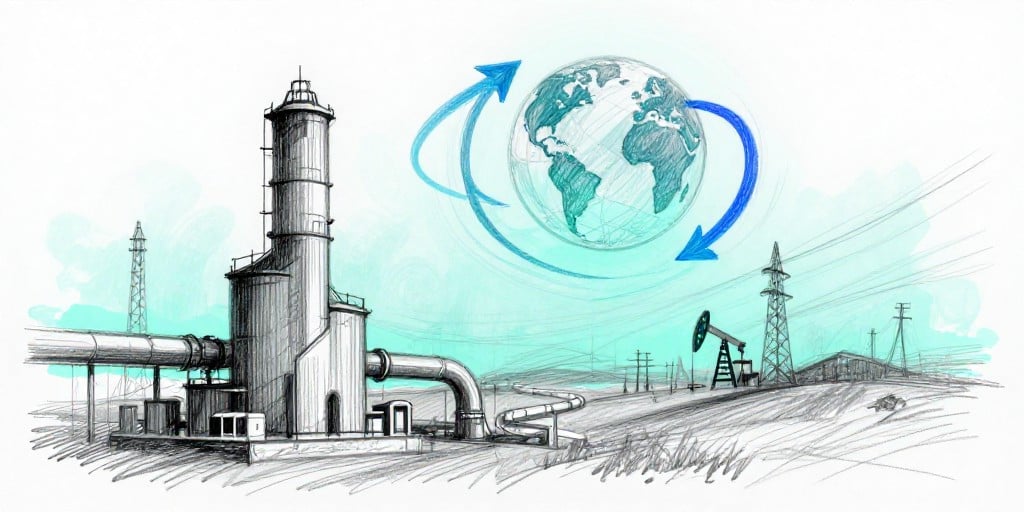
Energy Markets Under the Lens: Production, Storage, and Regulatory Dynamics
The global energy landscape continues to evolve amid a confluence of technical, economic, and geopolitical forces. As traditional fossil‑fuel production grapples with fluctuating demand and renewables expand their market share, the role of storage and the regulatory environment remain pivotal in shaping industry trajectories. This article examines the critical drivers influencing both conventional and renewable sectors, highlighting how policy decisions and geopolitical developments interact with market fundamentals.
Production Trends in Conventional Energy
Oil and Natural Gas Supply Chains
Production volumes in the upstream sector have plateaued in many mature basins, while unconventional plays—shale and tight gas—maintain growth momentum in the United States and parts of Latin America. Technological advances in hydraulic fracturing and horizontal drilling continue to push extraction limits, yet marginal reserves increasingly drive operating costs higher. Consequently, the price elasticity of supply has tightened; a modest dip in spot prices can trigger significant declines in investment in high‑cost projects.
Impact of Geopolitical Tensions
Ongoing geopolitical frictions, particularly in the Middle East, affect crude oil supply through both direct disruption and market sentiment. Sanctions on key producers, regional conflicts, and shifting alliances contribute to volatility in the West Texas Intermediate (WTI) benchmark. Meanwhile, the energy‑dependent economies of the European Union face heightened scrutiny of their import strategies, prompting diversification into alternative sources and the acceleration of domestic production where feasible.
Renewable Energy Production Dynamics
Solar and Wind Capacity Expansion
The solar PV and onshore wind markets have achieved record deployment rates in 2025, driven by declining capital costs and supportive national subsidies. In 2026, the cumulative installed capacity in North America surpassed 400 GW, with the United Kingdom and Germany maintaining leadership in wind. However, supply chain bottlenecks—particularly for critical raw materials such as silicon and rare earth metals—continue to constrain project timelines.
Grid Integration and Capacity Constraints
As renewable penetration rises, grid operators confront challenges in maintaining reliability. Variability in output necessitates flexible dispatchable resources, often supplied by natural gas peaker plants. In regions with stringent emissions targets, these gas plants operate at lower utilization rates, creating a mismatch between capacity and actual demand. Storage solutions are therefore essential for balancing supply and demand, as detailed below.
Storage as a Market Catalyst
Battery Energy Storage Systems (BESS)
Lithium‑ion battery installations have surged, with cumulative global capacity reaching 60 GW by mid‑2026. The decreasing cost curve, projected to reach $25/kWh by 2028, supports widespread adoption in both residential and utility‑scale applications. Battery storage now enables renewable energy to provide firm capacity, participate in ancillary services, and smooth price volatility, thereby improving the economic viability of renewable projects.
Pumped Hydro and Compressed Air
Traditional pumped‑hydro storage continues to dominate the large‑scale energy storage landscape, accounting for roughly 70% of global installed capacity. However, its geographic dependence limits scalability. Compressed‑air energy storage (CAES) offers an alternative with lower land‑use requirements, but faces engineering challenges related to heat management and efficiency.
Regulatory Incentives for Storage
Several jurisdictions have introduced feed‑in tariffs and capacity payments for storage, recognizing its role in decarbonization. In the United States, the Inflation Reduction Act provides tax credits for battery storage, while the European Green Deal mandates a minimum 10% renewable share of total electricity generation by 2030, implicitly encouraging storage deployment.
Regulatory Landscape and Policy Implications
Carbon Pricing and Emissions Standards
Carbon pricing mechanisms, such as the EU Emissions Trading System and California’s cap‑and‑trade program, impose a direct cost on fossil‑fuel emissions. These policies accelerate the shift toward renewables and low‑carbon storage options. The recent announcement of a 2.6% annual increase in the EU’s carbon price underscores the tightening of regulatory pressure on gas and coal producers.
Subsidy Structures and Market Liberalization
The transition from fixed subsidies to performance‑based incentives in many countries has altered project economics. For example, the United Kingdom’s Renewable Heat Incentive now rewards measurable heat savings, fostering investment in heat pumps and biogas. Market liberalization efforts, such as the expansion of the European Energy Exchange, increase price transparency but also heighten competition among generators.
Geopolitical Considerations in Energy Security Policy
National security concerns influence energy policy, as seen in the United States’ recent restrictions on importing Russian liquefied natural gas (LNG) and the EU’s push for diversification of supply chains. These actions can shift production patterns, alter trade flows, and create opportunities for domestic renewable development.
Economic Factors Shaping Investment
Cost of Capital and Investor Sentiment
Investment decisions in both conventional and renewable energy are increasingly sensitive to the cost of capital. The sustained low interest rates of the post‑pandemic era have facilitated capital allocation toward long‑term renewable projects. However, rising inflationary pressures and tightening monetary policy may reverse this trend, elevating the hurdle rates for new initiatives.
Market Demand and Energy Transition Roadmaps
Corporate power purchase agreements (PPAs) have proliferated as businesses seek to lock in renewable energy at fixed rates. The proliferation of these contracts reflects a broader commitment to decarbonization and provides revenue certainty for renewable developers. In contrast, demand for natural gas remains robust in regions with limited renewable penetration, sustaining investment in conventional projects.
Conclusion
Energy markets today are governed by a complex interplay of production capabilities, storage technologies, regulatory frameworks, and geopolitical realities. Conventional energy producers face rising marginal costs and stricter carbon regulations, while renewable projects benefit from declining capital expenses and supportive policy measures. Storage solutions, both battery‑based and hydro‑mechanical, are becoming indispensable for grid stability and the realization of renewable energy targets.
For investors, the landscape presents a nuanced mix of risks and opportunities. Long‑term fundamentals—such as diversified service portfolios and resilient contract pipelines—continue to attract insider confidence, even amid short‑term volatility. Meanwhile, the rapid expansion of storage technologies and evolving regulatory incentives are likely to shape the competitive dynamics of the energy sector for years to come.