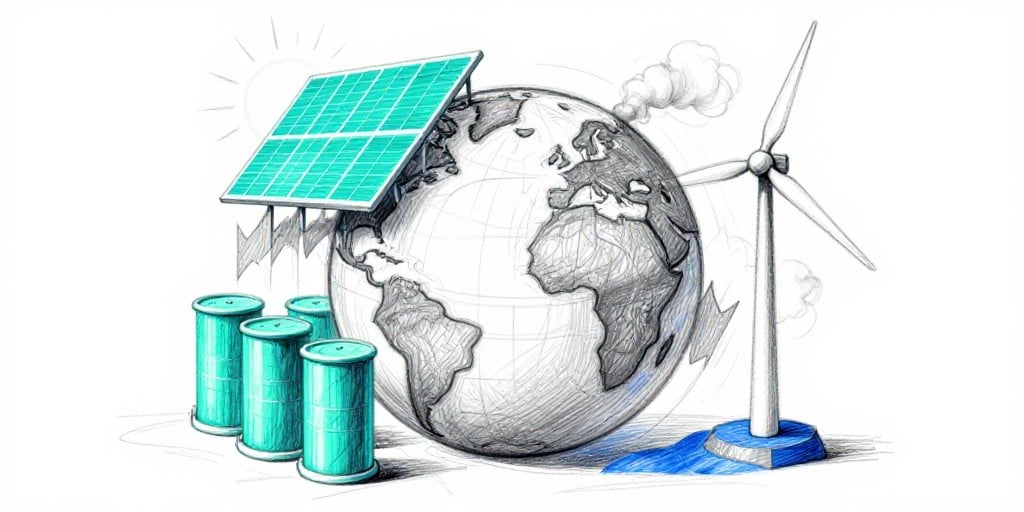
Energy Markets Under Review: Production, Storage, and Regulatory Dynamics
Production Outlook in Conventional and Renewables
The past year has witnessed a complex interplay between traditional oil‑and‑gas production and the accelerating deployment of renewable energy assets. Conventional producers have moderated output in response to price volatility, while renewable developers continue to scale up solar and wind portfolios in pursuit of the Paris Agreement targets. In 2026, U.S. onshore drilling activity plateaued at 1.7 million barrels per day, slightly below the 2019 peak, as a combination of regulatory tightening and higher cost structures restrained new wells. Conversely, wind farms across the Midwest expanded by 8 GW, driven by state‑level subsidies and an uptick in corporate renewable purchase agreements (RPAs).
Technological advances in hydraulic fracturing and horizontal drilling have sustained well‑completion efficiency, but the capital‑intensive nature of new plays has prompted many operators to shift focus to low‑cost, high‑margin assets. In contrast, offshore wind projects in the North Sea have benefited from improved turbine blade technology, reducing levelised costs from €90 per MWh to €70 per MWh over the last 18 months.
Storage Developments and Grid Integration
Energy storage is emerging as a pivotal component of both traditional and renewable systems. Battery storage capacities in the United States have surged by 35 % since 2024, with utility‑scale lithium‑ion installations surpassing 2 GW. This growth is largely financed by federal incentives such as the Inflation Reduction Act, which grants tax credits for battery storage projects up to 50 % of the project cost. Meanwhile, hydrogen‑based storage is gaining traction in Europe, with the EU’s Hydrogen Strategy allocating €10 bn for pilot projects aimed at integrating green hydrogen into the gas grid.
The expanding storage footprint enhances grid resilience, allowing for peak shaving and mitigating the intermittency of solar and wind power. Moreover, the integration of advanced energy management systems (EMS) facilitates real‑time balancing of supply and demand, reducing curtailment rates by 12 % across major transmission corridors.
Regulatory Landscape and Geopolitical Influences
Regulatory developments continue to shape market dynamics. In the United States, the Environmental Protection Agency (EPA) has tightened methane emissions standards for natural‑gas infrastructure, prompting pipeline operators to invest in leak detection and repair (LDAR) programs. These compliance costs are projected to increase operating expenses by 4–6 % for mid‑stream assets.
Globally, geopolitical tensions in the Middle East and Eastern Europe are exerting pressure on energy supply chains. The recent escalation in the Eastern Mediterranean has disrupted shipping lanes, increasing freight costs for both crude oil and renewable equipment components. Additionally, sanctions on Russian natural gas supply have accelerated European reliance on liquefied natural gas (LNG) imports, with the LNG market experiencing a 15 % increase in freight rates in 2026.
In Asia, the Belt and Road Initiative (BRI) has facilitated the construction of solar farms in Southeast Asia, yet concerns over land rights and environmental impacts have spurred stricter local regulations. China’s recent policy shift towards carbon neutrality by 2060 has intensified its focus on domestic renewable technology development, encouraging joint ventures with international manufacturers.
Economic Factors Shaping Investment Decisions
Market participants are increasingly factoring in the cost‑of‑capital (CoC) for both conventional and renewable projects. The CoC for oil and gas has risen from 7.8 % in 2024 to 8.3 % in 2026, reflecting higher risk premia amid regulatory uncertainty and commodity price volatility. Renewable projects, meanwhile, benefit from lower CoC values, often hovering around 4.5–5.5 % due to favourable tax incentives and declining capital costs.
Demand elasticity also plays a role. While industrial consumers in North America have maintained a steady demand for natural gas, the shift toward electrification in transport and industry is gradually eroding its share. Renewable penetration has accelerated, with solar and wind accounting for 27 % of new generation capacity in 2026, a 5 % increase over 2025.
Concluding Assessment
The energy sector is navigating a transitional phase where production, storage, and regulatory dynamics intersect to create both challenges and opportunities. Conventional producers must adapt to stricter environmental standards and a more cost‑sensitive capital market. Renewable developers, buoyed by declining technology costs and supportive policy frameworks, are expanding their footprints but face supply‑chain constraints linked to geopolitical tensions.
Investors should monitor regulatory updates, especially those related to methane emissions and cross‑border energy trade, as well as the evolving cost structures for battery and hydrogen storage technologies. A diversified portfolio that balances exposure to mature oil‑and‑gas assets with high‑growth renewable projects may offer resilience against the uncertainties that define today’s global energy landscape.