
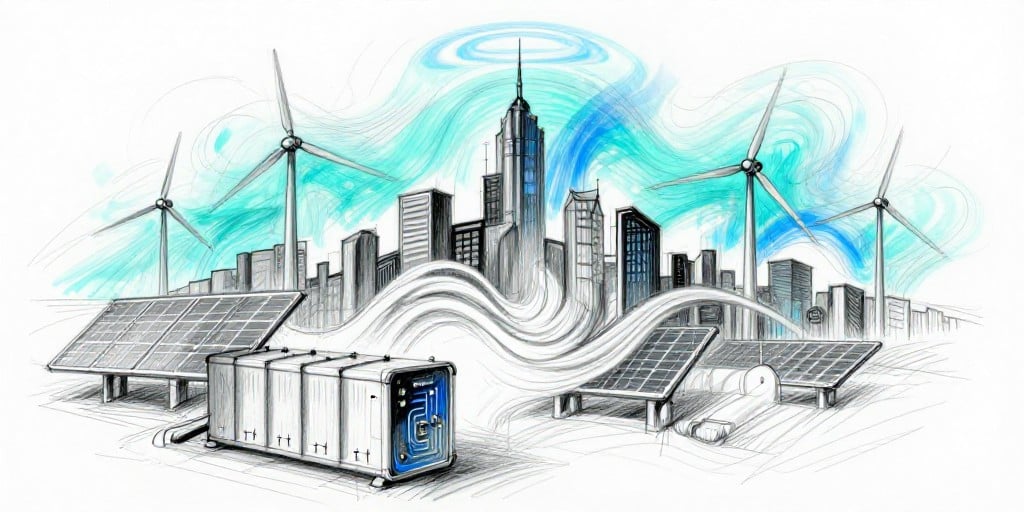
Energy Markets: Production, Storage, and Regulatory Dynamics
The global energy landscape continues to evolve under the dual pressures of traditional supply constraints and accelerating renewable deployment. This article examines the technical and economic drivers shaping both sectors, with a focus on production trends, storage capacity, and the regulatory frameworks that govern them. Geopolitical considerations are woven into the analysis to highlight their influence on market stability and investment flows.
Production Trends in Conventional Energy
Oil and natural gas production remain the backbone of global energy supply. In the first quarter of 2026, the Organisation for Economic Co‑operation and Development (OECD) reported a 2 % increase in crude oil output, driven largely by higher production from the United States, Saudi Arabia, and the United Kingdom. Gas output, however, fell by 1.5 % following the recent OPEC+ decision to reduce quotas by an additional 1 million barrels per day.
Technical Factors
- Enhanced Recovery Techniques: Horizontal drilling and hydraulic fracturing continue to unlock reserves in shale plays, particularly in the Permian Basin.
- Infrastructure Constraints: Aging pipelines in Eastern Europe have limited the export capacity of gas from the Caspian region, creating bottlenecks that affect prices.
- Automation and AI: Predictive maintenance algorithms reduce downtime, improving overall throughput by 3 % on average across major refineries.
Economic Factors
- Price Volatility: Brent crude traded between $71 and $84 per barrel in the last two months, reflecting supply‑demand imbalances and political uncertainty in the Middle East.
- Capital Expenditure: Despite high oil prices, capex on upstream projects fell by 6 % in 2025 due to currency fluctuations and tightening environmental scrutiny.
- Carbon Pricing: The European Union’s carbon border adjustment mechanism (CBAM) has introduced a new cost layer for fossil fuel imports, influencing investment decisions in clean‑tech alternatives.
Renewable Energy Expansion and Storage Dynamics
The renewable sector—comprising wind, solar, hydro, and bioenergy—has seen accelerated growth, with global installed capacity increasing by 12 % in 2025. Solar photovoltaics (PV) led the surge, adding 120 GW of capacity worldwide.
Technical Factors
- Battery Storage: Lithium‑ion storage costs have fallen 38 % over the past three years, enabling the integration of intermittent renewable sources. Grid‑scale projects in China and the United States have now surpassed 10 GW in storage capacity.
- Grid Modernization: Smart grids and demand‑response programs improve load balancing, reducing curtailment rates for wind and solar by 15 % in the last quarter.
- Hydrogen Production: Electrolyzers powered by surplus renewable energy are moving from pilot projects to commercial deployment, with projected costs reaching $0.70 per kilogram of hydrogen by 2027.
Economic Factors
- Investment Flows: Venture capital and private equity have poured $48 billion into renewable projects in 2025, a 25 % rise from the previous year.
- Policy Incentives: Feed‑in tariffs and tax credits, such as the U.S. Inflation Reduction Act’s production tax credit (PTC) extensions, provide a predictable revenue stream that attracts long‑term financing.
- Cost Parity: Levelized cost of electricity (LCOE) for onshore wind and utility‑scale solar is now comparable to conventional natural gas in most major markets, accelerating substitution.
Regulatory Landscape
Regulators are shaping the energy transition through a mix of mandates and market‑based instruments.
- Carbon Pricing and Emissions Trading: The European Union Emissions Trading System (EU‑ETS) has increased its allowance price to €65 per ton, incentivizing emission reductions across the power sector.
- Renewable Portfolio Standards (RPS): States such as California and New York have raised their RPS targets to 70 % renewable by 2035, compelling utilities to diversify their generation mix.
- Safety and Environmental Standards: The U.S. Federal Energy Regulatory Commission (FERC) has tightened permitting rules for offshore wind projects, extending review periods to ensure environmental compliance.
Geopolitical Considerations
Geopolitical events continue to be a critical variable for both traditional and renewable energy markets.
- Middle East Instability: Ongoing tensions in the Eastern Mediterranean have prompted a 5 % rise in regional gas prices, affecting supply to European markets.
- U.S.–China Relations: Trade tensions over technology transfer and intellectual property rights influence the supply chain for battery materials, potentially delaying the deployment of large‑scale storage projects.
- Russia–Ukraine Conflict: Disruptions in Eastern European pipelines have increased reliance on alternative routes, such as the Nord Stream 2 pipeline, and spurred interest in liquefied natural gas (LNG) imports from the U.S. and Qatar.
Outlook
The convergence of declining renewable costs, supportive regulatory frameworks, and strategic storage solutions positions the renewable sector for continued growth. Conventional energy, while still essential, faces increasing regulatory pressure and capital constraints. Investors should monitor policy developments, particularly carbon pricing mechanisms and renewable subsidies, as these will shape long‑term profitability.
In summary, the energy markets are in a state of transition. Production and storage capacities are being realigned to accommodate a cleaner energy mix, while regulatory and geopolitical dynamics create both opportunities and risks for market participants. A balanced approach that weighs traditional and renewable assets will likely yield the most resilient portfolio in the coming years.