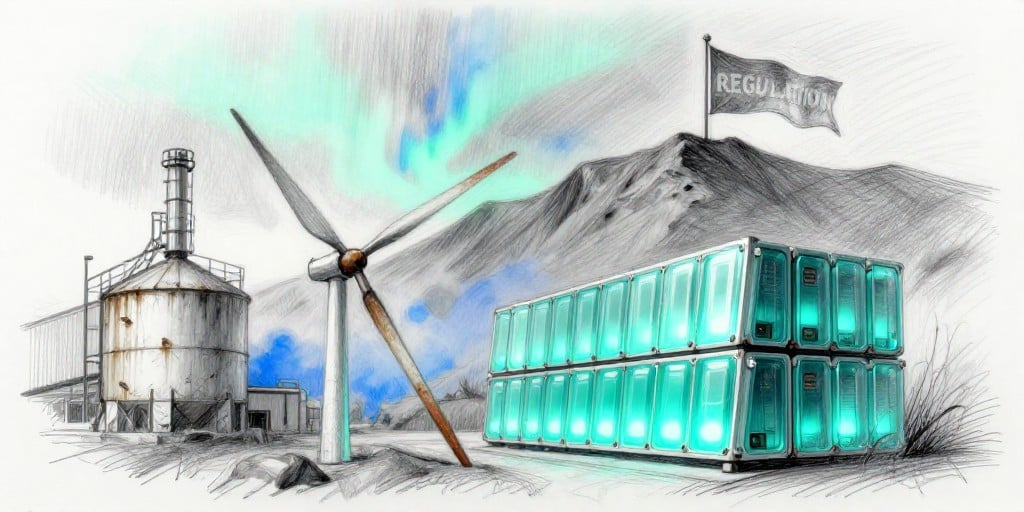
Energy Markets Outlook: Production, Storage, and Regulation
The current energy landscape is shaped by a confluence of production dynamics, storage constraints, and evolving regulatory frameworks that affect both conventional hydrocarbon sources and renewable portfolios. Recent institutional actions—such as the significant divestiture of Gran Tierra Energy Inc. by Equinox Partners—offer a micro‑level illustration of how market sentiment can shift even when underlying fundamentals remain strong. In this analysis, we examine the technical and economic drivers at play, contextualize geopolitical influences, and assess implications for investors across the energy spectrum.
1. Conventional Energy Production: Resilience Amid Uncertainty
1.1. Supply Chain and Operational Efficiency
Petroleum and natural‑gas extraction continue to benefit from advances in drilling technology and cost‑management practices. Horizontal drilling and hydraulic fracturing have reduced per‑barrel acquisition costs, while digital twins and AI‑driven predictive maintenance further shorten downtime. These efficiencies help offset the volatility that has plagued the sector during geopolitical shocks and supply‑side disruptions.
1.2. Production Decline and Asset Monetization
Despite operational gains, the industry is grappling with the inevitability of declining production rates in mature basins. Asset owners, including those in the South American region, are increasingly exploring asset‑sale or joint‑venture models to monetize reserves before they fall below economic thresholds. The Gran Tierra sell‑off by Equinox Partners, for instance, may signal an anticipation of a production ramp‑up that could compress share value as the company rebalances its asset base.
1.3. Pricing Pressure and Market Sentiment
Oil and gas pricing remains sensitive to OPEC+ production decisions, supply‑side curtailments, and demand forecasts. Institutional traders often interpret price spikes as short‑term catalysts, prompting opportunistic exits when valuation multiples appear overextended. The pattern observed in Equinox Partners’ trading—accumulating near 52‑week lows and divesting during sharp uptrends—reflects this tactical approach. Such behavior can create short‑term liquidity fluctuations, especially when large institutional blocks are liquidated.
2. Renewable Energy: Storage and Integration Challenges
2.1. Battery Technology and Grid Decarbonization
The rapid deployment of solar and wind installations has outpaced the development of large‑scale storage solutions. Lithium‑ion batteries, while cost‑effective, face challenges in scaling to grid‑level capacity and ensuring long‑term durability. Emerging technologies—such as flow batteries and solid‑state chemistries—promise higher energy density and safer operation, but commercial readiness lags behind demand.
2.2. Economics of Storage Investment
From an economic perspective, the value of storage depends on the ability to capture arbitrage opportunities, provide ancillary services, and smooth intermittent generation. The cost of a megawatt‑hour of storage has fallen from roughly $200 in 2010 to below $60 in 2024, yet the break‑even point remains highly location‑dependent. Policy incentives, carbon pricing, and regional demand profiles play pivotal roles in determining the return on investment.
2.3. Regulatory Dynamics
Government mandates for renewable portfolio standards, carbon pricing, and net‑metering rules are accelerating the deployment of storage technologies. However, regulatory uncertainty—particularly in the United States where federal and state policies can diverge—creates a complex investment landscape. In contrast, European jurisdictions are increasingly standardizing grid codes to facilitate storage participation, potentially offering clearer revenue streams for investors.
3. Geopolitical Considerations
3.1. South American Energy Geopolitics
South America remains a strategically important region for both hydrocarbons and renewable resources. Political stability, fiscal policy, and infrastructure investment decisions directly influence production schedules and export capacities. The Gran Tierra sell‑off occurs against a backdrop of heightened scrutiny over sovereign risk and commodity export regulations, which may affect future asset valuations.
3.2. Global Supply Chain Constraints
Trade tensions and pandemic‑related disruptions have exposed vulnerabilities in the global supply chain for critical components—especially those used in renewable infrastructure, such as photovoltaic cells and battery cathodes. Diversification of supply sources and increased domestic manufacturing capacity are being pursued to mitigate these risks.
3.3. Energy Security and Geopolitical Risk Premiums
Geopolitical events—ranging from sanctions on major oil producers to regional conflicts—impose risk premiums on conventional energy assets. Conversely, renewable projects located in politically stable regions may attract lower risk premiums, enhancing their appeal to risk‑averse investors. The interplay between geopolitical stability and energy pricing continues to shape investment decisions across the sector.
4. Technical and Economic Interplay Across the Energy Mix
| Energy Segment | Key Technical Driver | Economic Factor | Geopolitical Influence |
|---|---|---|---|
| Oil & Gas | Drilling efficiency, digital twins | Production cost, OPEC+ supply | Export tariffs, resource nationalism |
| Natural Gas | Compressor tech, LNG infrastructure | Liquidity, pipeline capacity | U.S. shale policy, Eurasian gas transit |
| Solar PV | Photovoltaic cell efficiency, mounting systems | CAPEX decline, grid parity | Renewable mandates, trade tariffs |
| Wind | Turbine blade design, offshore platforms | OPEX, subsidy regimes | Maritime regulations, export controls |
| Battery Storage | Cathode chemistry, thermal management | Capital cost per MWh, revenue streams | Battery supply chain security, carbon pricing |
The matrix above underscores how technical advancements and economic incentives interact differently across the energy spectrum, while geopolitical factors exert a unifying influence on all segments.
5. Investor Implications
Liquidity Management Institutional sell‑offs, such as those by Equinox Partners, can erode the active float, potentially increasing volatility if subsequent traders follow suit. Investors should monitor institutional activity as a barometer for short‑term liquidity.
Fundamental Strength vs. Technical Timing Robust fundamentals—illustrated by Gran Tierra’s strong exploration pipeline—can coexist with tactical sell‑offs driven by short‑term technical factors. Long‑term investors should differentiate between a genuine shift in value and a temporary rebalancing.
Geopolitical Risk Allocation Exposure to South American hydrocarbon assets carries distinct sovereign risk considerations. Diversifying across regions and energy types can mitigate concentration risk.
Renewable Investment Timing The cost trajectory of storage technologies and evolving grid codes present a window for investors to capture value before widespread adoption drives prices higher.
6. Conclusion
The energy markets are navigating a complex terrain defined by production efficiencies, storage technology evolution, and regulatory shifts. Institutional behavior—exemplified by the Equinox Partners sell‑off—provides a useful indicator of market sentiment but should be weighed against underlying technical and economic fundamentals. Geopolitical dynamics continue to modulate risk profiles across the energy spectrum, reinforcing the need for a diversified, data‑driven investment strategy. As the sector transitions toward a more integrated, low‑carbon future, investors who align technical insights with macro‑economic and geopolitical realities are better positioned to capitalize on emerging opportunities.