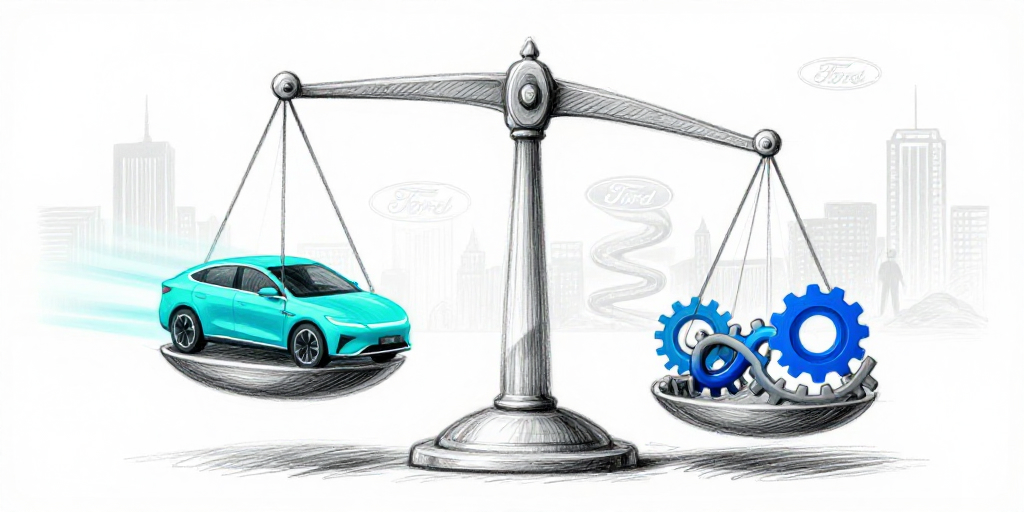
Insider Confidence Amid a Volatile Market
Ford Motor Company’s latest insider filing reveals a significant purchase of 137,581 restricted stock units (RSUs) by Vice Chair John T. Lawler on January 15, 2026. The transaction, valued at the current share price of $13.60, is part of a broader long‑term incentive plan that will vest in December 2026. This move occurs against a backdrop of market softness, as Ford’s stock closed at $13.81 on the previous day following a 4.23 % decline over the week.
Recent Insider Activity: A Snapshot
| Date | Owner | Transaction Type | Shares | Price per Share | Security |
|---|---|---|---|---|---|
| 2026‑01‑15 | Lawler John T. (Vice Chair) | Buy | 137,581.00 | 0.00 | Ford Stock Units |
Other senior executives engaged in mixed trading on the same day. Chief Operating Officer Ashwani Kumar executed both sizable purchases and sales of common stock and Ford Stock Units (FSUs). Chief Counsel Steven Croley acquired a substantial block of common shares before liquidating a portion of FSUs. Historically, Ford’s executive family has been a net buyer, with recent large‑scale purchases by William Clay Jr. and Alexandra Ford in December 2025.
Market Fundamentals and Competitive Landscape
Electrified Mobility Transition Ford’s executive purchases signal continued confidence in the company’s electrified mobility strategy. The timing of the RSU acquisition coincides with ongoing discussions with BYD regarding hybrid battery sourcing, hinting at an imminent shift in product mix toward hybrid and electric vehicles.
Supply Chain Diversification The prospective partnership with BYD indicates an effort to diversify supply chains and reduce dependence on U.S. and European battery suppliers. This aligns with industry trends driven by geopolitical risks and the tightening of global semiconductor and battery supply.
Regulatory Environment In the United States, tightening emissions standards and incentives for electric vehicles create a favorable regulatory backdrop for Ford’s transition. However, the company must navigate complex tariff regimes in China and Europe, especially if BYD‑derived components are imported.
Competitive Landscape Ford competes with traditional automakers such as General Motors, Stellantis, and Toyota, as well as new entrants like Rivian and Lucid. The shift to hybrid technology positions Ford in direct competition with Toyota’s hybrid dominance and GM’s Ultium platform. The partnership with BYD could provide a competitive edge through cost‑effective battery technology.
Hidden Trends, Risks, and Opportunities
| Category | Trend / Opportunity | Risk / Challenge |
|---|---|---|
| Talent & Governance | RSU purchase reflects commitment to retain top talent and align incentives with long‑term goals. | Potential dilution if RSUs vest and are sold en masse post‑vesting. |
| Capital Allocation | Increased insider confidence may attract institutional inflows. | Market volatility and social‑media scrutiny could trigger short‑term selling. |
| Supply Chain | BYD partnership offers cost savings and supply stability. | Dependence on a single foreign partner introduces geopolitical risk. |
| Product Innovation | Hybrid focus may bridge gap between internal combustion and full electric. | Rapid technology evolution could render hybrid strategy obsolete if EV adoption accelerates. |
| Regulatory Compliance | Alignment with emissions standards enhances brand image. | Stricter future regulations may require additional R&D investment. |
Investor Implications
- Bullish Signals: Insider confidence, analyst upgrades from UBS and TD Cowen, and a potential BYD partnership all point to positive fundamentals.
- Volatility Indicators: A modest 0.02 % price dip and a 135 % social‑media buzz suggest heightened market sensitivity.
- Liquidity Considerations: The RSU vesting schedule in December 2026 could precipitate a sizable share sale if executives choose to liquidate, impacting the share price.
- Strategic Patience: Investors should adopt a cautious yet hopeful stance, monitoring the progress of the hybrid transition, supply‑chain developments, and the timing of insider liquidity events.
Conclusion
Ford’s insider activity, particularly the sizable RSU purchase by Vice Chair John T. Lawler, underscores a strategic focus on electrified mobility and supply‑chain resilience. While the company faces regulatory, competitive, and geopolitical challenges, the alignment of executive incentives with long‑term goals provides a solid foundation for navigating the evolving automotive landscape. Investors should remain vigilant for the December 2026 vesting event, ongoing BYD collaboration milestones, and broader market sentiment shifts that could influence Ford’s share performance.