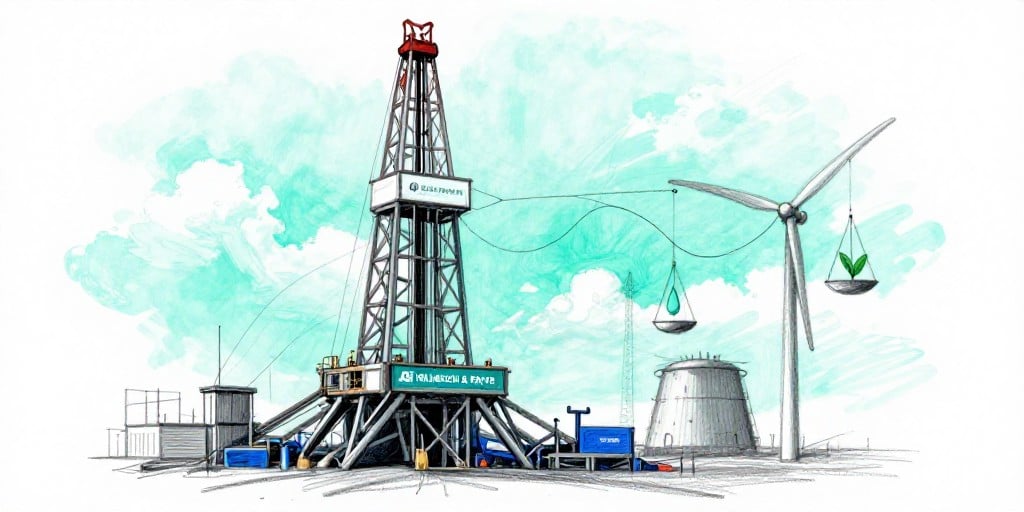
Corporate Analysis: Insider Transactions and Energy Market Dynamics
Insider Activity at Helmerich & Payne
A recent Form 4 filing disclosed that Executive Vice‑President Lennox Michael sold 5,000 shares of Helmerich & Payne’s common stock on 22 July 2026 under a Rule 10(b)(5)(1) trading plan. The sale was executed at an average price of $35.00, slightly below the market close of $42.97 on 11 August 2026. Although the transaction represents only about 0.13 % of the company’s outstanding shares, it is part of a broader pattern of insider activity that may signal a shift in sentiment among senior management.
Over the past year, Michael has sold shares on multiple occasions—most notably 2,912 shares on 11 December 2025 and 831 shares on 12 January 2026—while also acquiring 2,436 shares on the same day. His recent sale of 5,000 shares brings his holdings down to 181,037, a decrease of roughly 15 % since the beginning of the year. Other executives, such as CFO Todd Scruggs and VP Sara Momper, have also sold shares in July, indicating a broader trend of off‑balance‑sheet liquidity management rather than a coordinated divestiture.
The consistent selling pattern raises two questions for investors: (1) Are insiders anticipating a downturn in the energy services sector, or (2) are they simply exercising pre‑planned trading windows to meet personal liquidity needs? While the sales are routed through a Rule 10(b)(5)(1) plan—mitigating concerns about insider speculation—they do not eliminate the possibility that the market’s perception of the company’s future prospects may be shifting.
Helmerich & Payne’s recent quarterly results showed a 27.65 % month‑over‑month increase in revenue, and the company’s 52‑week high of $43.14 suggests that the market still values its drilling contracts. However, the negative price‑earnings ratio of –26.71 indicates that earnings are not yet translating into shareholder value, and the energy sector remains exposed to commodity volatility. If insiders continue to sell, it could amplify selling pressure, especially if market sentiment turns negative—an effect compounded by the current 98.66 % social‑media buzz, which is above average intensity.
From a strategic perspective, the company may need to communicate more proactively about its long‑term growth plans and cost‑management initiatives to reassure both insiders and investors. A transparent discussion about how the company plans to navigate fluctuating oil and gas prices could help stabilize share‑price volatility and mitigate the perception that insiders are “dumping” shares.
Technical and Economic Factors Shaping Energy Markets
Production Trends
Globally, conventional hydrocarbon production has plateaued in several key regions. In the United States, the decline in new oil discoveries has been offset by a resurgence of shale plays, particularly in the Permian Basin, where drilling activity remains robust. Production growth in natural gas, driven largely by the U.S. shale sector, continues to outpace demand, contributing to a modest surplus on the global market.
Renewable energy production, meanwhile, is expanding at an accelerated pace. Solar photovoltaic installations have surpassed 600 GW of cumulative capacity, while offshore wind farms have added 15 GW in 2026 alone. The rapid deployment of battery storage technologies—particularly lithium‑ion and flow‑cell systems—has improved the reliability of intermittent renewables, allowing them to compete more directly with fossil‑fuel baseload power.
Storage Developments
Energy storage is a critical enabler for both traditional and renewable sectors. In the conventional sector, large‑scale thermal and pumped‑hydro storage facilities are being integrated into natural‑gas pipelines to provide flexibility and grid support. For renewables, grid‑scale batteries are reducing curtailment rates, while vehicle‑to‑grid (V2G) platforms are emerging as a new storage vector. The cost of lithium‑ion batteries has declined by approximately 30 % year‑over‑year, making them increasingly attractive for utility‑scale projects.
Regulatory Dynamics
Regulatory frameworks are evolving to accommodate the shifting energy mix. In the United States, the Biden administration has expanded the Clean Power Plan, introducing stricter emissions standards for new natural‑gas plants and incentivizing carbon capture and storage (CCS) technologies. The European Union’s Fit‑for‑55 package targets a 55 % reduction in greenhouse‑gas emissions by 2030, which will require significant investments in renewable generation and storage.
In addition, the U.S. Treasury Department has increased scrutiny of “tax‑payer‑friendly” oil‑and‑gas subsidies, potentially tightening the fiscal environment for exploration and production companies. Conversely, the Inflation Reduction Act (IRA) of 2022 provides substantial tax credits for renewable energy projects, thereby accelerating the transition away from fossil fuels.
Geopolitical Considerations
Geopolitical tensions continue to influence energy markets. The ongoing instability in the Middle East has led to periodic spikes in crude‑oil prices, while sanctions on major producers such as Iran and Russia have altered supply dynamics. In 2026, the U.S. export of liquefied natural gas (LNG) to Europe has surged, reducing the region’s dependence on Russian gas and altering the global LNG trade routes.
Additionally, the geopolitical rivalry between the United States and China is reshaping the renewable sector. China’s aggressive expansion of solar and wind capacity—combined with strategic investments in battery storage—has positioned it as a key supplier of critical minerals such as lithium, cobalt, and nickel. This has prompted the U.S. to accelerate domestic production of these minerals and to establish supply‑chain diversification strategies.
Investor Implications
Helmerich & Payne’s insider selling trend, coupled with the broader energy market dynamics described above, suggests that investors should monitor the following:
- Liquidity Needs vs. Strategic Outlook – Continued insider sales may reflect routine liquidity management rather than a signal of distress, but they can amplify selling pressure if market sentiment turns negative.
- Commodity Volatility – Fluctuations in oil and gas prices, influenced by geopolitical events and supply‑side constraints, could affect the company’s revenue streams and profitability.
- Regulatory Shifts – Tightening emissions standards and incentives for renewables could alter the demand for traditional drilling services, potentially impacting long‑term growth prospects.
- Technological Disruption – Advances in renewable energy and storage technology may reduce the reliance on conventional drilling operations, necessitating strategic diversification.
By maintaining transparent communication about its operational performance, cost‑management initiatives, and long‑term growth strategy, Helmerich & Payne can reinforce investor confidence and mitigate the perception that insider sales reflect a negative outlook.