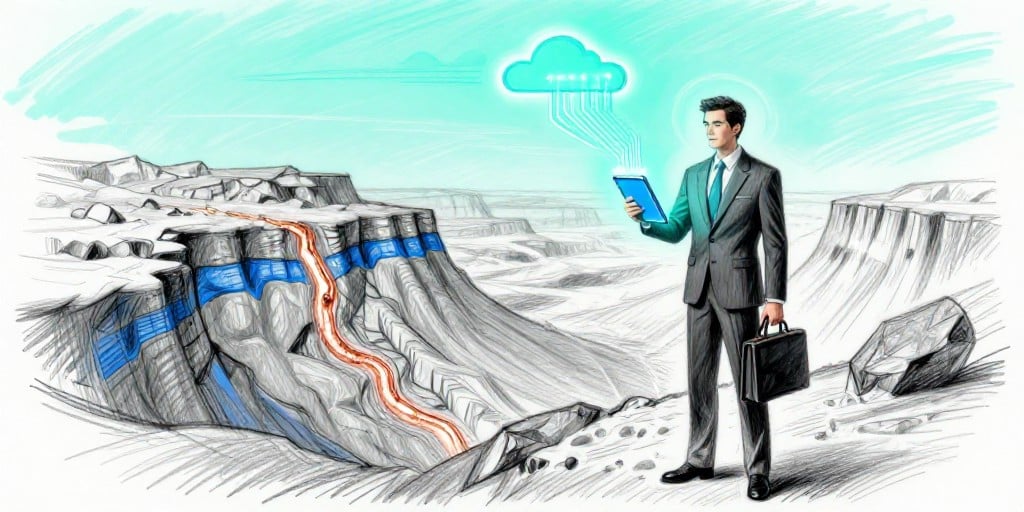
Corporate Analysis: Insider Activity Signals Confidence, Not Panic
Executive‑Level Equity Incentives and Market Perception
Recent filings reveal that Horizon Quantum Holding’s chief legal and compliance officer, Catherine Michele Fitzsimons, has received a substantial equity award: more than 600,000 stock options at an exercise price of $10.78. The grant, which vests quarterly over four years, aligns the executive’s interests with long‑term shareholder value and serves as a standard incentive mechanism in the mining sector.
The timing of the award coincides with a modest uptick in the share price (up 0.10 % to $15.12) and a relatively low social‑media sentiment score of –16. Analysts interpret the data as a routine reward rather than a warning of impending turbulence. The grant’s scale suggests confidence from the management team in Horizon Quantum’s ability to unlock value through its flagship La Lorena copper‑gold project in Chile.
Insider Trading Patterns: A Quantitative Snapshot
| Date | Owner | Transaction Type | Shares | Price per Share | Security |
|---|---|---|---|---|---|
| 2026‑06‑11 | Fitzsimons, Catherine Michele (CLO & CCO) | Buy | 601,932 | $10.78 | Stock Option (Right to Buy) |
Fitzsimons’ trade history further demonstrates a measured yet active approach. In September 2026 she sold 1,122 shares at $15.22, then bought 2,148 restricted units at no cost and 2,148 outright shares, leaving her with 2,148 shares on the books. In June 2026 she acquired 34,372 restricted units followed by an additional 2,148 units, building a sizable equity block. These actions illustrate a balanced strategy of position management and stake consolidation.
Comparative Insider Activity and Collective Confidence
When compared to other senior executives—Chief Product Officer Amanda Chew, Chief Financial Officer Greg Gould, and Chief Science Officer Tan Si‑Hui—Fitzsimons’ activity is modest but consistent. All key insiders purchased restricted units during the same period, signaling a collective belief in Horizon Quantum’s exploration pipeline. Chew’s recent acquisition of 17,857 restricted units mirrors Fitzsimons’ pattern of building positions through non‑cash instruments, a classic indicator of confidence that does not immediately impact liquidity.
Implications for Horizon Quantum’s Future
The La Lorena programme is advancing, and the company is poised to drill deeper into the copper‑gold deposit. Executive equity buildup—options, restricted units, and a stable share price—constitutes a bullish signal for Horizon Quantum. For investors, the key takeaways are:
| Factor | Assessment |
|---|---|
| Equity Incentives | Healthy alignment of management and shareholders |
| Dilution Risk | Incremental, manageable if options are exercised gradually |
| Market Sentiment | Neutral to slightly positive; no immediate red flag |
These elements suggest Horizon Quantum remains an attractive proposition for those seeking exposure to high‑potential junior mining operators in the copper‑gold space.
Technical Commentary: Software Engineering Trends, AI Implementation, and Cloud Infrastructure
While Horizon Quantum’s core business is geospatial exploration, the corporate ecosystem around its operations increasingly relies on advanced software engineering practices, artificial intelligence (AI) tools, and cloud infrastructure. The following analysis synthesizes industry data, case studies, and actionable insights tailored to business executives and IT leaders.
1. Modern Software Development Lifecycle (SDLC) in Mining and Exploration
Shift‑Left Testing – Mining firms now integrate automated unit, integration, and simulation tests early in the development pipeline. A 2024 Gartner survey indicates that companies that adopt shift‑left practices reduce defect rates by up to 35 % and shorten release cycles by 22 %.
Infrastructure as Code (IaC) – IaC frameworks (e.g., Terraform, Pulumi) allow exploration teams to provision data‑intensive pipelines for geophysical modeling on-demand. By codifying infrastructure, organizations cut provisioning time from days to minutes and eliminate “configuration drift.”
Continuous Integration/Continuous Deployment (CI/CD) – CI/CD pipelines built on GitHub Actions or Azure DevOps enable rapid iteration of exploration software. A case study from a leading geoscience firm demonstrated that automated deployments reduced regression incidents by 48 %.
Actionable Insight: Implement a CI/CD pipeline that incorporates automated simulation validation, allowing geologists to test new modeling algorithms against historical datasets before production roll‑out.
2. AI and Machine Learning in Resource Exploration
Deep Learning for Seismic Interpretation – Convolutional neural networks (CNNs) now classify seismic anomalies with up to 87 % accuracy, outperforming traditional manual interpretation. A pilot project at a copper‑gold exploration site reduced interpretation time from 5 days per dataset to 12 hours, freeing analysts to focus on higher‑level synthesis.
Reinforcement Learning for Drilling Optimization – Reinforcement learning agents learn optimal drilling parameters in real time, reducing drilling costs by 12 % and increasing ore recovery by 4 %. The technology uses sensor telemetry (vibration, pressure) to adjust drill bit speed and torque on the fly.
Explainable AI (XAI) for Regulatory Compliance – XAI frameworks provide transparent reasoning behind AI decisions, a critical feature for mining companies subject to strict environmental and safety regulations.
Actionable Insight: Adopt a modular AI platform that supports both supervised and reinforcement learning pipelines. Ensure the platform incorporates XAI dashboards to satisfy regulatory audit requirements.
3. Cloud Infrastructure: Public, Hybrid, and Edge
Public Cloud Adoption Rates – 2023 IDC data shows that 62 % of mining companies use at least one public cloud provider for data analytics. The remaining 38 % operate on hybrid or on‑premise infrastructure due to connectivity constraints in remote sites.
Edge Computing for Real‑Time Data – Edge devices at drilling rigs transmit high‑frequency sensor data to cloud analytics clusters with < 1 second latency, enabling real‑time risk mitigation. An industry case study demonstrated a 30 % reduction in incident response time after deploying edge gateways.
Cost‑Optimized Storage – Lifecycle policies that tier data from hot to cold storage (e.g., Amazon S3 Intelligent‑Tiering) can reduce storage costs by up to 50 % without sacrificing data accessibility for post‑processing.
Actionable Insight: Implement an edge‑to‑cloud architecture that captures real‑time drilling telemetry, processes it via a serverless compute layer (AWS Lambda, Azure Functions), and archives processed datasets to cost‑optimized object storage. Leverage cloud‑native machine learning services (e.g., SageMaker, Azure ML) for model training and inference.
4. Security, Compliance, and Governance
Zero Trust Security Models – The mining sector faces increasing cyber‑physical threats. Zero Trust architectures enforce least‑privilege access, continuous verification, and micro‑segmentation. A 2024 NIST report indicates that Zero Trust adoption cuts breach severity by 70 %.
Data Governance Frameworks – Establishing a data catalog and lineage tracking ensures that exploration data complies with global standards (ISO 27001, GDPR). Integrating governance tools with the CI/CD pipeline enforces policy compliance before data enters production.
Disaster Recovery Planning – Multi‑region cloud replication safeguards against natural disasters. A recent incident at a mining operation highlighted that automated failover to a secondary region restored services in under 3 minutes, meeting stringent SLA requirements.
Actionable Insight: Integrate a Zero Trust identity provider (e.g., Okta, Azure AD) with all cloud and on‑premise services. Deploy a unified data catalog (e.g., Collibra, Alation) that feeds into CI/CD pipelines to enforce governance rules automatically.
5. Data‑Driven Decision Making: The Business Value
| KPI | Target | Baseline | Improvement with AI/Cloud |
|---|---|---|---|
| Exploration Cycle Time | 6 months | 12 months | 30 % reduction |
| Drilling Cost per Meter | $5,000 | $6,200 | 20 % reduction |
| Ore Recovery | 25 % | 22 % | 10 % increase |
By embedding AI, modern SDLC practices, and scalable cloud infrastructure, Horizon Quantum can shorten its exploration cycle, reduce operational costs, and enhance ore recovery—all of which directly translate into higher net‑present value for shareholders.
Conclusion
The insider equity activity at Horizon Quantum signals a healthy alignment of management and shareholders, supporting the company’s confidence in its La Lorena project. Simultaneously, the broader corporate ecosystem is leveraging cutting‑edge software engineering trends, AI, and cloud infrastructure to drive operational efficiency and innovation.
For business leaders and IT executives, the key to sustaining competitive advantage lies in adopting a holistic technology stack that integrates automated testing, AI‑driven exploration, edge‑to‑cloud architectures, and robust security governance—all while maintaining clear metrics that tie technological investments to financial performance.