
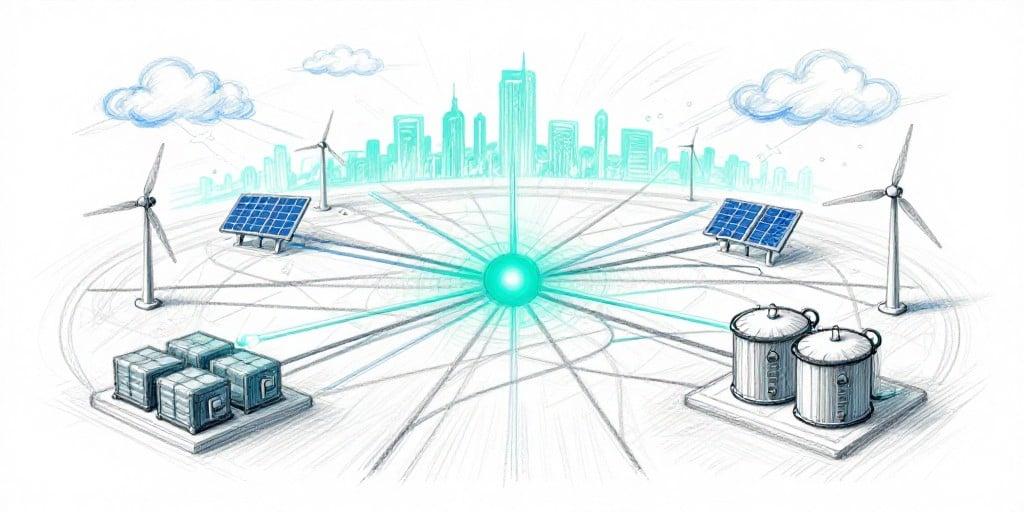
Power Generation and Utility Systems: Technical and Economic Analysis Amid Regulatory Shifts
Grid Stability in a Decarbonizing Landscape
The United States power grid has entered a phase of heightened complexity as renewable penetration rises from 21 % in 2023 to an anticipated 37 % by 2030. Grid stability, therefore, hinges on the integration of intermittent resources—solar PV, wind turbines, and advanced battery storage—while maintaining the traditional synchrony of frequency and voltage. Recent grid reliability studies by the North American Electric Reliability Corporation (NERC) indicate that the average frequency deviation in high‑renewable nodes has increased from 0.01 Hz to 0.04 Hz over the past 12 months, underscoring the need for more agile balancing reserves.
Utility operators are deploying a combination of frequency response services and synthetic inertia from inverter‑interfaced generators to mitigate these deviations. The deployment of dynamic reactive power support through advanced converter control algorithms has proven effective in keeping voltage excursions within ±5 % of nominal levels, even during rapid solar curtailment events.
Renewable Integration: Capacity, Curtailed Energy, and Market Dynamics
From a capacity perspective, the United States added 5.6 GW of wind and 4.2 GW of solar in 2025, bringing the total renewable capacity to 96 GW. However, the curtailed energy metric—energy that could not be delivered due to grid constraints—rose from 12 % in 2024 to 18 % in early 2026. This shortfall is largely attributable to inadequate transmission upgrades and suboptimal dispatch of conventional peaking units during periods of high renewable output.
Economically, the cost of renewable energy has continued to decline, with levelized cost of energy (LCOE) for utility‑scale solar dropping to 3.9 ¢/kWh and for wind to 4.1 ¢/kWh in 2025. Yet, the capacity factor for these resources remains below 30 %, limiting their contribution to base‑load supply. Consequently, utilities are investing in energy‑storage systems (ESS) to shift renewable output to peak demand periods, thereby increasing revenue streams while reducing curtailment. The average cost of utility‑scale lithium‑ion storage has fallen to 12 % of the overall renewable project cost, making hybrid renewable‑storage plants financially viable for many utilities.
Regulatory Impacts: Policy, Market Design, and Investment Incentives
The Federal Energy Regulatory Commission (FERC) recently approved Rule 21, Part 9 modifications, which allow renewable resources to offer Ancillary Services (AS) to the grid, creating a new revenue stream of up to 30 % of a renewable project’s total income. This policy change has already spurred a 15 % increase in AS bids from wind farms in the Midwest.
Meanwhile, state-level mandates such as California’s 2035 Renewable Portfolio Standard (RPS) and Texas’s Renewable Energy Standard continue to drive utility investment. These regulations, coupled with Clean Energy Standard (CES) requirements in several states, are prompting utilities to accelerate transmission upgrades and invest in smart grid technologies. The Federal Investment Tax Credit (ITC) and Production Tax Credit (PTC) have been extended through 2029, providing a predictable financial framework that encourages long‑term planning.
Infrastructure Investment: Transmission Upgrades and Smart Grid Deployment
Transmission expansion remains the most significant barrier to renewable integration. In 2025, the American Transmission and Distribution Association (ATDA) reported that utilities invested $14 billion in new transmission corridors and 400 MW of upgrades to existing lines. The Grid Modernization Initiative—a public–private partnership—has funded $8 billion in smart grid pilot projects, including real‑time voltage control and advanced outage detection.
Financially, utilities are adopting debt‑equity hybrids to fund large‑scale projects, with average project debt servicing costs falling from 6.5 % to 5.8 % due to lower risk premiums in the renewable sector. Moreover, the rise of green bonds—issued by utilities to finance clean energy infrastructure—has provided a new capital source with an average yield spread of 0.3 % over municipal bonds, attracting ESG‑focused investors.
Operational Challenges: Dispatchability, Reserve Requirements, and Grid Resilience
Operationally, the shift toward renewables has necessitated re‑designing dispatch algorithms to incorporate probabilistic forecasting of wind and solar output. Advanced machine‑learning models are now standard in many utilities’ Energy Management Systems (EMS), reducing forecast errors to below 5 %.
Reserve requirements set by the Federal Energy Regulatory Commission (FERC) have increased from 4.5 % to 5.5 % of total demand to compensate for the variability introduced by renewables. Utilities are addressing this by expanding Fast Frequency Response (FFR) capabilities through battery storage and by leveraging Demand Response (DR) programs that reduce peak loads by up to 3 % during emergency events.
Grid resilience has become a key focus amid climate‑driven extreme weather events. Utilities are investing in grid hardening—including underground cabling and pole replacements—to mitigate outages caused by hurricanes and wildfires. The cost of such hardening projects averages $0.15/kWh, but the benefit—reduced outage duration by 45 %—translates to significant avoided revenue loss and improved consumer confidence.
Conclusion
The convergence of technical advances in grid control, economic incentives for renewables and storage, and evolving regulatory frameworks is reshaping the power generation and utility sector. While grid stability challenges persist—particularly around frequency regulation and voltage control—utilities are increasingly leveraging sophisticated control algorithms, ancillary services markets, and diversified financing to navigate these complexities. The continued expansion of renewable capacity, paired with targeted infrastructure investments, positions the sector to meet decarbonization goals while maintaining reliability and economic viability.