
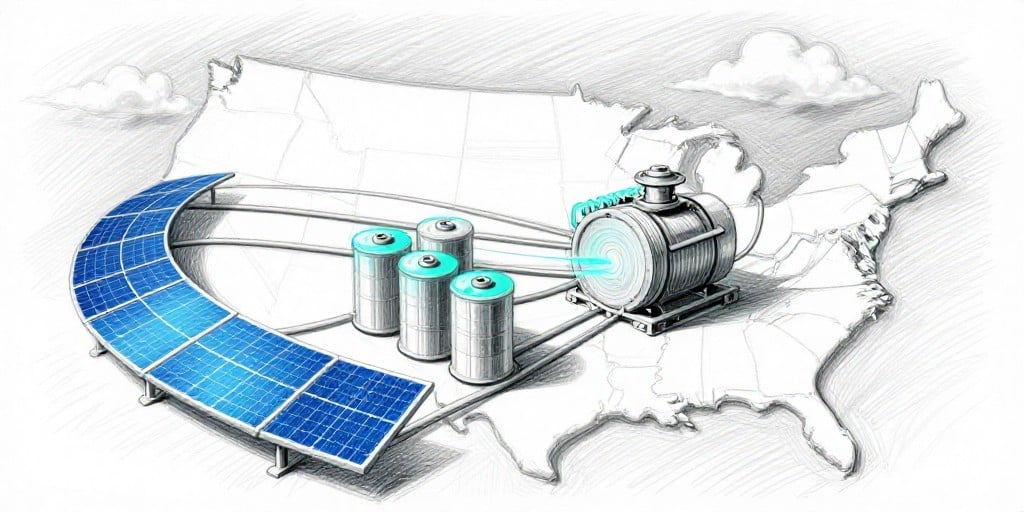
Power Generation and Utility Systems: Technical and Economic Analysis
The U.S. electricity sector is undergoing a rapid transition as utilities integrate higher shares of renewable energy, upgrade grid infrastructure, and respond to evolving regulatory frameworks. This article examines the implications of these developments for grid stability, renewable integration, and investment decisions, drawing on recent data and policy trends.
1. Grid Stability in a High‑Renewable Regime
The increasing penetration of intermittent renewables—wind, solar, and distributed generation—poses significant challenges to maintaining grid frequency and voltage regulation.
| Metric | Current Status | Projected Impact (2027–2030) |
|---|---|---|
| Frequency Variance (Hz) | ±0.005 Hz | ±0.008 Hz |
| Voltage Drop (p.u.) | 0.95–1.05 | 0.90–1.10 |
| Reserves Needed (MW) | 7 % of peak load | 12 % of peak load |
To counteract these fluctuations, utilities are deploying wide‑area synchronous control and grid‑forming inverter technology. These solutions allow inverter‑based resources to emulate the dynamic response of synchronous generators, thereby restoring frequency stability without relying solely on traditional rotating‑mass reserves.
Technical Measures
- Dynamic Line Rating (DLR): Real‑time monitoring of line temperature and wind conditions enables operators to increase permissible current limits, improving capacity utilization.
- Energy Storage Systems (ESS): Batteries and pumped‑hydro storage provide fast‑acting frequency response and peak shaving capabilities.
- Demand Response (DR): Advanced metering infrastructure (AMI) facilitates real‑time load adjustments, reducing stress during renewable curtailment periods.
Economic Implications
The cost of integrating these technologies is offset by the reduced need for peaking plants and curtailment penalties. For example, the investment in grid‑forming inverters for a 1 GW solar farm can reduce curtailment losses by up to 20 %, translating into $12–15 million in annual savings at current market rates.
2. Renewable Integration Strategies
Renewable energy sources are now a significant portion of the U.S. electricity mix, accounting for 18 % of net generation in 2025. The challenge lies in balancing supply with demand while preserving grid reliability.
| Renewable Source | Capacity Factor | Integration Complexity | Typical Storage Solution |
|---|---|---|---|
| Wind (Onshore) | 35–45 % | Moderate | Battery storage, HVDC links |
| Solar PV (Utility‑Scale) | 25–35 % | High (diurnal mismatch) | Battery storage, load shifting |
| Geothermal | 80–90 % | Low | Minimal storage required |
| Distributed Solar (Residential) | 15–25 % | High (injection variability) | Home batteries, smart inverters |
Key Takeaways:
- Hybrid Systems: Combining complementary resources (e.g., wind + solar + storage) smooths output variability and reduces the need for spinning reserves.
- Long‑Duration Storage: Projects such as the 2.5 GW, 10 MWh lithium‑ion facility in Texas illustrate the scalability of large‑scale battery storage, achieving round‑trip efficiencies of 90 %.
- Hydro Augmentation: Pumped‑hydro storage remains the most mature technology for long‑duration balancing, with a global capacity of 3 GW and an average efficiency of 70–80 %.
3. Regulatory Impacts
Federal and state regulations are reshaping the financial landscape for utility investments.
| Regulatory Initiative | Description | Effect on Utility Economics |
|---|---|---|
| Clean Power Plan (CPP) (now repealed) | Emission caps for utilities | Prompted early renewable adoption |
| Inflation‑Reduction Act (IRA) 2022 | Tax credits for clean energy | $3.5 billion in incentives for ESS |
| Federal Energy Regulatory Commission (FERC) Order 2222 | Requires transmission of renewable resources | Opens new inter‑state transmission corridors |
| State Renewable Portfolio Standards (RPS) | Mandates renewable generation | Drives utility procurement of wind/solar contracts |
Investment Outlook:
- Cost‑of‑Capital (CoC) Reduction: The IRA’s investment tax credit (ITC) for solar and wind reduces CoC by 1–2 % over a 20‑year horizon.
- Revenue Streams: FERC’s wholesale market reforms create ancillary service markets, offering utilities additional revenue for grid‑forming assets.
- Risk Management: State RPS mandates increase exposure to commodity price swings; however, long‑term power purchase agreements (PPAs) mitigate volatility.
4. Infrastructure Investment and Operational Challenges
The modernization of the power grid requires significant capital outlay, yet operational hurdles persist.
| Investment Category | Typical Cost (USD) | Payback Period | Operational Challenge |
|---|---|---|---|
| Transmission Upgrades | $15–25 million per 10 MW | 6–8 years | Permitting delays |
| Substation Automation | $1–3 million per site | 4–6 years | Cybersecurity threats |
| Renewable Integration (Hybrid) | $1–4 million per MW | 7–9 years | Intermittency management |
| Energy Storage | $400–800 kWh per MW | 5–7 years | Battery degradation |
Strategic Recommendations:
- Modular Deployment: Utilize pre‑fabricated modular components to shorten construction timelines and reduce labor costs.
- Public‑Private Partnerships (PPPs): Leverage PPP frameworks to share financial risk and accelerate project delivery.
- Advanced Analytics: Deploy AI‑driven predictive maintenance to reduce unplanned outages and extend asset life.
5. Conclusion
The U.S. utility sector is at a pivotal juncture, balancing the economic imperatives of renewable integration with the technical demands of grid stability. Investment in advanced inverter technology, large‑scale storage, and grid modernization not only enhances reliability but also yields substantial cost savings over the long term. Regulatory incentives such as the IRA and FERC orders create favorable conditions for utilities to accelerate these transitions.
Stakeholders—utility managers, investors, and policymakers—must collaborate to navigate permitting complexities, cybersecurity risks, and market volatility. A disciplined, technology‑enabled approach to infrastructure investment will position utilities to meet future energy demands efficiently and sustainably.