Insider Commitments Reflect Strategic Confidence in New Horizon Aircraft’s Manufacturing Trajectory
The recent wave of insider transactions at New Horizon Aircraft Ltd. (HOVR) underscores a pronounced confidence in the company’s evolving production capabilities and the broader industrial ecosystem that underpins its hybrid eVTOL platform. Between the Head of People and Strategy, Lee Stewart Murray, and the Chief Executive Officer, Eric Brandon Robinson, a collective purchase of 1 312 500 performance share units (PSUs) was executed on February 10 , 2026. The magnitude of these orders—ranging from 250 000 PSUs for the COO to 500 000 PSUs for the CEO—signals a robust alignment of managerial incentives with long‑term productivity goals and capital‑intensive growth strategies.
Capital Allocation and Production Scaling
New Horizon’s recent capital commitments have centered on the acquisition of high‑throughput assembly lines for its hybrid eVTOL architecture. The company’s latest funding round, which raised $65 million at a $81.9 million valuation, was earmarked for the procurement of automated lift‑jet integration stations, laser‑based composite lay‑up rigs, and an advanced supply‑chain orchestration platform powered by edge‑computing analytics. These investments are intended to reduce cycle times by an estimated 30 % and increase output capacity from 30 units per annum to 120 units within the next 18 months.
From an industrial‑technology perspective, the shift toward additive‑manufacturing (AM) of composite airframes, coupled with robotic disassembly for maintenance cycles, reflects a broader trend in the aerospace sector to lower labor intensity while maintaining stringent safety margins. By embedding real‑time sensor arrays on the production floor, New Horizon can monitor structural health indicators (SHI) and predict component fatigue, thereby mitigating costly post‑manufacturing defects and accelerating time‑to‑market for new models.
Productivity Gains Through Integrated Digital Twins
Central to New Horizon’s productivity strategy is the deployment of digital twin models that simulate the entire eVTOL life cycle—from material procurement to flight testing. These twins enable predictive maintenance scheduling and allow engineers to iterate design changes virtually, cutting down physical prototyping phases by up to 45 %. The use of high‑fidelity finite‑element analysis (FEA) and computational fluid dynamics (CFD) within the twin environment ensures that aerodynamic performance targets are met before any physical construction occurs.
The capital outlay for such digital infrastructure—estimated at $12 million—has been justified by projected cost‑of‑goods (COG) reductions of 18 % over the next five fiscal years. Moreover, the integration of blockchain‑based traceability for critical components introduces an additional layer of supply‑chain transparency that is increasingly demanded by both regulators and end‑users in the urban air mobility (UAM) market.
Technological Trends and Their Macro‑Economic Impact
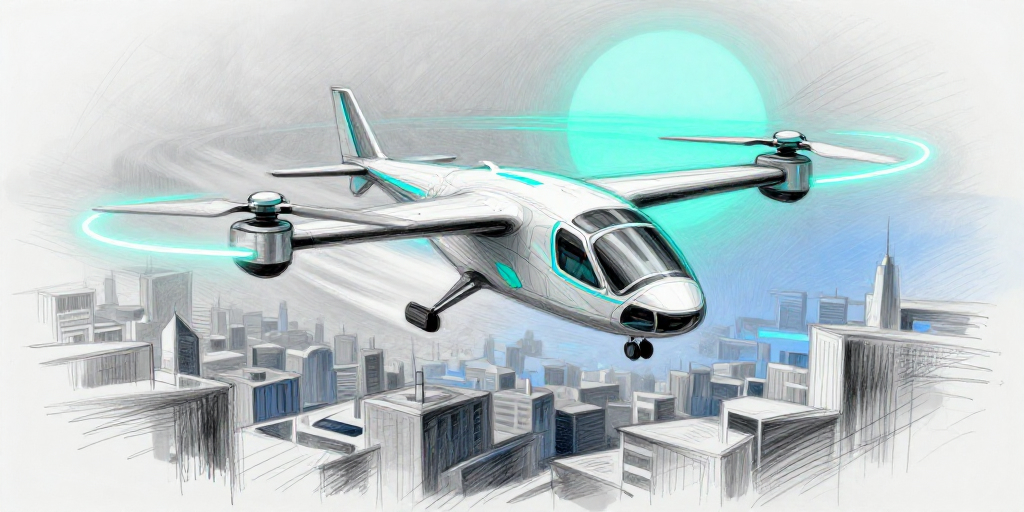
The eVTOL sector is a bellwether for the broader shift toward sustainable, electric‑powered transport. New Horizon’s hybrid propulsion architecture, which combines hydrogen fuel cells for take‑off and electric motors for cruise, positions the company at the nexus of two key growth corridors: green hydrogen infrastructure and advanced battery chemistry. As the U.S. and European governments push for decarbonized air transport, the demand for such dual‑mode platforms is expected to rise sharply, creating a multiplier effect on the manufacturing supply chain.
Capital investments in advanced manufacturing not only boost New Horizon’s internal productivity but also generate downstream economic benefits. By establishing a high‑skill workforce in the Midwest, the company supports local employment growth and enhances the region’s position as a hub for aerospace innovation. Furthermore, the adoption of Industry 4.0 practices—real‑time data analytics, autonomous robotics, and AI‑driven quality control—aligns with national initiatives to maintain technological leadership in critical sectors.
Insider Activity as a Signal of Management Alignment
The simultaneous purchase of PSUs by executives whose compensation is tied to market‑capitalization milestones and performance metrics reflects a strategic bet on the company’s future trajectory. Given the current market cap of $81.9 million and a share price of $1.80—well below its 52‑week high of $4.18—the insiders are essentially staking long‑term equity on the expectation that the capital investments will translate into accelerated production and profitability. This alignment of interests reduces agency costs and signals to investors that management’s incentives are closely coupled with shareholder value creation.
From a liquidity perspective, the PSUs’ vesting conditions—market‑cap thresholds and performance relative to the Russell Microcap Index—imply that the insiders’ holdings will remain locked until a significant price appreciation occurs. While this limits short‑term liquidity, it also fosters a disciplined, long‑term investment horizon that can stabilize stock volatility over the medium term.
Conclusion
New Horizon Aircraft’s recent insider purchases, coupled with its aggressive capital allocation toward automated, digitally integrated manufacturing, signal a decisive move toward higher productivity and scalable production. The company’s focus on hybrid propulsion technology positions it favorably within the expanding urban air mobility market, while its commitment to Industry 4.0 practices aligns with broader industrial trends aimed at enhancing competitiveness and sustainability. For investors monitoring the company’s path toward its analyst‑set target of $11, the alignment of executive incentives with tangible production milestones offers a compelling narrative of disciplined growth and strategic confidence.