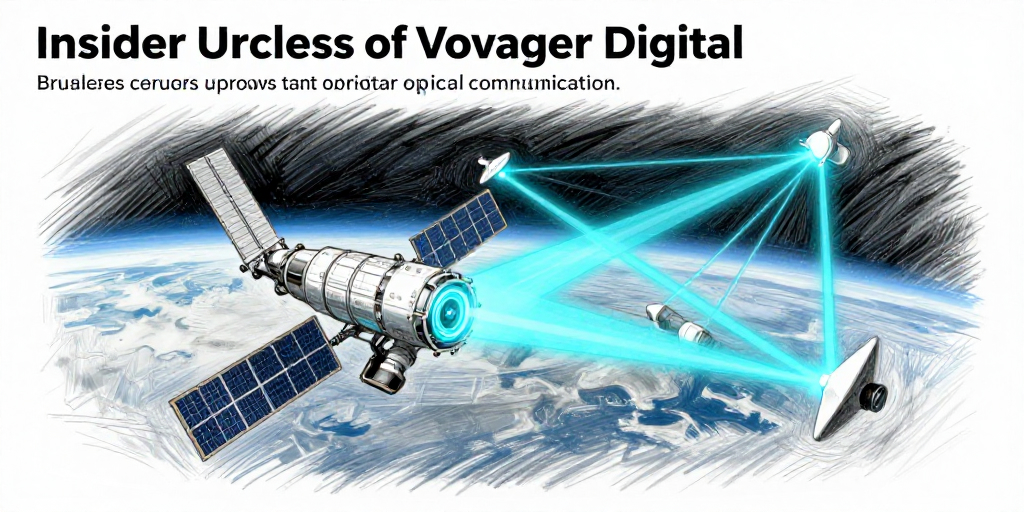
Insider Purchases at Voyager Digital Signal Strategic Reorientation and Heighten Cybersecurity Considerations
The filing of several “buy” transactions on January 13 , 2026 by Voyager Digital’s senior executives and directors indicates a deliberate realignment of management incentives toward long‑term shareholder value. While the nominal cash outlay—approximately $0.00015 per share—is effectively zero, the concentration of acquisitions in Class A common stock and associated options reflects a confidence in a forthcoming pivot from brokerage services to high‑technology infrastructure, as underscored by the company’s recent patent filing for orbital optical communications.
1. Insider Activity as a Governance Signal
The transactions involve key figures—including Magana Matthew, Vernal Margaret J., Kuta Matthew James, and Taylor Dylan—who have collectively purchased hundreds of thousands of shares and options. The pattern of acquiring equity at the current market price, coupled with sizable options grants (e.g., 150 000 shares to Taylor Dylan), demonstrates a willingness to stake personal wealth on the success of Voyager’s new strategic direction. From a governance perspective, such moves are generally viewed positively, as they align management interests with those of the broader shareholder base and can mitigate concerns over short‑term volatility.
2. Emerging Technology: Orbital Optical Communications
Voyager Digital’s filing for an orbital optical communications patent signals an ambition to move beyond traditional brokerage functions toward providing high‑performance, low‑latency data links in space. This technology could unlock new revenue streams—such as satellite‑to‑ground data relay services for defense, telecommunications, or scientific research—potentially justifying a higher valuation for the company.
Societal implications are notable. Satellite‑based optical communication promises faster global connectivity, but it also raises questions about space traffic management, orbital debris mitigation, and equitable access to space infrastructure. Regulatory frameworks, such as the International Telecommunication Union’s (ITU) frequency allocation policies and national space agency licensing regimes, will play a crucial role in shaping the commercial viability of such systems.
3. Cybersecurity Threat Landscape
The shift toward space‑based infrastructure amplifies cybersecurity risks. High‑throughput optical links are attractive targets for advanced persistent threat (APT) actors seeking to intercept sensitive data or disrupt service. Moreover, the integration of satellite systems with terrestrial networks introduces new attack vectors—such as:
| Threat Vector | Description | Mitigation Strategy |
|---|---|---|
| Spaceborne Malware | Software designed to infect onboard processors or communication payloads | Hardened firmware, signed code execution, continuous integrity verification |
| Signal Jamming / Spoofing | Intentional interference with optical links to degrade performance | Adaptive beamforming, multi‑frequency redundancy, anomaly detection |
| Supply‑Chain Compromise | Third‑party components (e.g., lasers, sensors) tampered with before launch | Vendor vetting, secure procurement policies, hardware attestation |
| Cloud‑Based Control Exploits | Compromise of ground‑station control centers used to manage satellites | Zero‑trust network architecture, MFA for privileged access, real‑time telemetry monitoring |
Real‑world examples include the 2023 SolarWinds supply‑chain breach, where attackers compromised a widely used network management platform, and the 2021 incident involving a Ukrainian satellite operator that experienced a targeted signal jamming attack. These events illustrate that even infrastructure considered “space‑grade” is not immune to sophisticated cyber operations.
4. Regulatory Implications for Cybersecurity
Regulators are increasingly attentive to the cyber‑physical security of space assets. The U.S. Federal Communications Commission (FCC) and the Federal Aviation Administration (FAA) have begun issuing guidance on satellite licensing that incorporates cybersecurity requirements. In the European Union, the Space Situational Awareness (SSA) framework now mandates risk assessments that include cyber‑resilience as a core component. Compliance with such regulations will be essential for Voyager to secure launch and operating licenses.
Additionally, data protection laws—such as the General Data Protection Regulation (GDPR) and the U.S. California Consumer Privacy Act (CCPA)—extend to data transmitted via satellite links. Voyager must ensure that encryption, access controls, and data‑handling procedures meet the stringent standards required for cross‑border data flows.
5. Actionable Insights for IT Security Professionals
Implement Zero‑Trust Architectures Treat all network segments, including satellite control and data‑relay nodes, as untrusted. Enforce strict authentication, authorization, and continuous verification of device integrity.
Adopt Hardware‑Based Root‑of‑Trust Use secure element chips and Trusted Platform Modules (TPM) to validate firmware before booting. This prevents unauthorized code from running on satellite onboard computers.
Develop Continuous Monitoring Pipelines Deploy telemetry analytics that flag anomalous patterns in signal strength, latency, or error rates, indicative of potential jamming or spoofing attacks.
Secure Supply‑Chain Processes Require signed cryptographic hashes for all hardware and software components. Maintain a tamper‑evidence log that is auditable by regulators and external auditors.
Ensure Compliance with International Standards Align security controls with ISO/IEC 27001, IEC 62443 for industrial control systems, and the emerging ISO 27701 for privacy‑by‑design. Regularly test and update policies to reflect new regulatory requirements.
Educate Personnel on Space‑Cyber Risks Conduct specialized training for engineers, operators, and executives on the unique threat landscape of orbital communications. Emphasize the importance of secure coding practices and incident response plans tailored to space operations.
6. Investor Perspective: Weighing Speculation and Opportunity
From an investor’s standpoint, the insider purchases suggest a strong belief in Voyager’s ability to monetize its orbital communications patent. However, the company’s market capitalization—just over $20 000—combined with a 52‑week low of $0.0001 underscores its speculative nature. The sizable options grant to Taylor Dylan, for instance, could become valuable if the company succeeds, but may also expire worthless if the venture falters. Investors should monitor:
- Earnings releases for indications of revenue streams beyond brokerage commissions.
- Patent commercialization milestones, such as licensing agreements or first‑to‑market deployments.
- Additional insider transactions, which may signal ongoing confidence or, conversely, a lack of conviction.
7. Conclusion
Voyager Digital’s recent insider activity reflects a strategic pivot toward high‑technology infrastructure, notably orbital optical communications. While such a shift promises diversified revenue and higher valuations, it also magnifies cybersecurity and regulatory challenges. IT security professionals must adopt rigorous, industry‑standard safeguards to protect both the integrity of spaceborne systems and the privacy of data traversing them. For investors, the insider purchases offer a cautiously optimistic signal—yet the inherent volatility of the market necessitates vigilant monitoring of technological progress, regulatory compliance, and subsequent corporate disclosures.